Most business owners and property managers in Christchurch and Auckland treat commercial cleaning as a procurement afterthought. They collect a few quotes, pick the lowest number, and sign a contract they have not read carefully. Six months later they are managing complaints from staff, fixing damage to floors or carpet, and starting the search all over again. Choosing the right provider for commercial cleaning in Christchurch or Auckland is not complicated, but it does require asking the right questions before you sign anything. This guide gives you a clear, practical framework to evaluate providers properly and avoid the mistakes that cost businesses time and money.
Table of Contents
- Why the Wrong Choice Is Costly
- Quick Takeaways
- Understand the Three Types of Cleaning Providers
- Insurance and Compliance: Non-Negotiables
- How to Evaluate Experience and Sector Fit
- Reading and Comparing Quotes
- What a Good Cleaning Contract Looks Like
- Red Flags to Watch Before You Sign
- Multi-City Operations: Christchurch and Auckland
- Frequently Asked Questions
- References
Why the Wrong Choice Is Costly
A poor commercial cleaning provider does not just leave dust on desks. It creates measurable operational problems: higher staff sick days in poorly maintained workplaces, failed hygiene audits in medical or food-handling environments, accelerated wear on floors and carpet from the wrong products, and damaged client impressions in reception and meeting areas.
The switching cost is also real. Moving from one cleaning provider to another means re-briefing site access, replacing missing consumables, and often dealing with a contract exit clause that locks you in for 30 to 90 days. Getting the selection right the first time is worth the extra effort at the start.
Quick Takeaways
| Key Insight | Explanation |
|---|---|
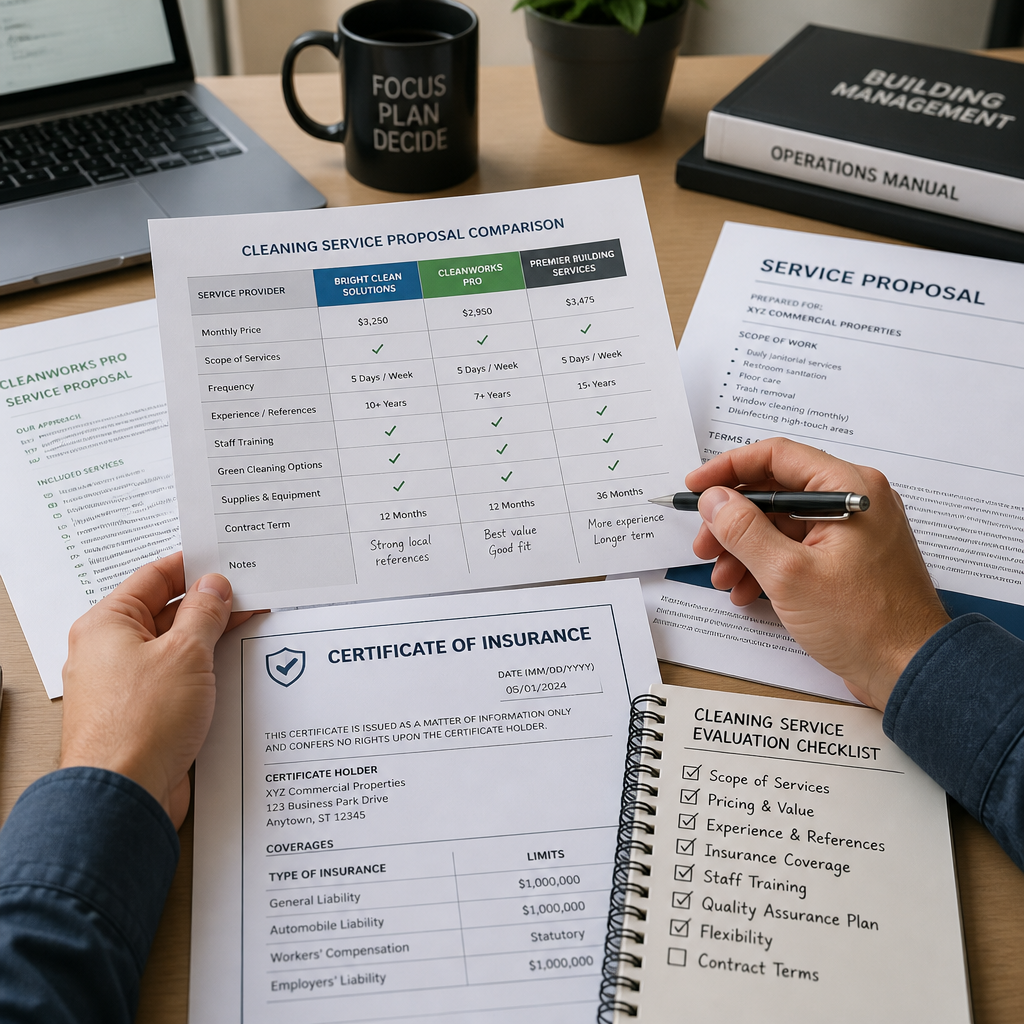
| Verify insurance with a certificate, not a verbal assurance | Ask for the insurer’s name and policy number. Confirm the policy covers all services you need, including specialist work like carpet cleaning or flood restoration. |
| Franchise brand does not guarantee consistent staff | In franchise models, the person cleaning your site is an independent franchisee, not a direct employee of the brand. Turnover and territory resale can change your crew without notice. |
| A quote below every other tender is a warning, not a win | Undercutting competitors requires cutting something: cleaning hours, product quality, or staff pay. The shortfall shows up in your site standards, not in the invoice. |
| UpstreamNZ approved supplier status is a meaningful differentiator | This accreditation means an independent programme has vetted the company for insurance, health and safety, and operating standards. It removes administrative burden for property managers. |
| Request a site-specific quote, not a phone estimate | Accurate pricing for commercial cleaning depends on actual site conditions: floor type, area, frequency, and access constraints. Remote estimates are guesses. |
| Ask for a cleaning checklist for a comparable site | A company that cannot show you a working checklist for a site like yours either does not use one or does not have relevant experience in your sector. |
| Confirm local staff and local management, not remote oversight | Whether your site is in Christchurch or Auckland, the team managing it should be physically based there. Remote management of a cleaning crew is a structural weakness. |
Before evaluating individual providers, it helps to understand what the commercial cleaning market in New Zealand actually looks like. The structure of the industry directly affects your experience as a client, and most business owners are not aware of it until something goes wrong.
Understand the Three Types of Cleaning Providers
The commercial cleaning market in Christchurch and Auckland is divided into three structural models, and understanding the differences will shape which questions you ask and what answers should satisfy you.
National Franchise Networks
Franchise brands such as CrestClean, Jani-King, and Crewcare sell territories to individual franchisees, who then service clients under the parent brand’s name. The franchisor provides training, systems, and marketing. The person actually cleaning your site is an independent businessperson with their own financial pressures and their own profit margin to protect.
The upside of this model is brand-level accountability and standardised systems. The downside is that franchise resale and franchisee turnover can mean your site changes hands without notice, and the franchisor is typically not responsive to individual site complaints. If your Christchurch site has a problem, you deal with one franchisee. If your Auckland site has a problem, you deal with a different one. A common mistake businesses make is assuming that a recognisable brand name guarantees consistent staff on the same site.
Independent Owner-Operators
Sole traders and small independent operators are often the most price-competitive option. They can be excellent for small, single-location businesses with simple cleaning needs. The risks are continuity (illness or personal circumstances can leave your site uncleaned), limited insurance coverage, and no capacity to scale if your cleaning requirements grow.
Established Mid-Sized Companies with Directly Employed Staff
Companies that directly employ their cleaning staff, rather than subcontracting, give clients a named contact, a consistent crew, and an employer-level obligation to maintain standards. This model suits medium and large commercial sites, medical centres, schools, and body corporate buildings where continuity and accountability matter. Triple Star Commercial Cleaning has operated this way across Christchurch and Auckland since 2015, and it is the model best suited to clients who need reliable outcomes without constant supervision.
The real cost of a cheap cleaning contract is never visible in the quote. It shows up in your next lease renewal inspection, your staff absenteeism data, and your client feedback.
Insurance and Compliance: Non-Negotiables
This section covers the compliance requirements that should be confirmed before any other conversation about price or scheduling. Skipping this step is the most common mistake made by business owners who have never managed a cleaning contract before.
Public Liability Insurance
Public liability insurance covers property damage and third-party injury caused by the cleaning company during their work on your site. The minimum acceptable level for a commercial site in New Zealand is typically $1 million, though $2 million is increasingly standard. Request a current certificate of currency. Do not accept a verbal confirmation. Ask for the insurer’s name and policy number, and confirm the policy covers all the services you are engaging, including specialist work like carpet cleaning, window cleaning, or flood restoration if those are part of your scope.
Health and Safety at Work Act 2015 Obligations
Under the Health and Safety at Work Act 2015, business owners and property managers share a duty of care for contractors working on their sites. A reputable commercial cleaning company should be able to provide documented HSWA compliance procedures on request. Ask for safety data sheets (SDS) for the products used on your site, particularly if you operate a medical centre, school, or food-handling environment where chemical compatibility matters.
UpstreamNZ Approved Supplier Status
UpstreamNZ is a procurement and supplier management programme used by New Zealand organisations to vet and approve service providers. Cleaning companies that hold UpstreamNZ approved supplier status have passed independent compliance checks covering insurance, health and safety standards, and operating practices. For property managers and facility teams that require documented supplier compliance, this accreditation reduces significant administrative burden. Triple Star Commercial Cleaning holds this status. When comparing providers, ask directly whether they participate in any recognised supplier vetting programme, and what documentation they can provide to support their compliance claims.
Pro tip: Always ask for the insurer’s name and policy number, not just a confirmation that insurance exists. Cross-check that the policy covers the type of work being performed, including any specialist services you may need periodically.
How to Evaluate Experience and Sector Fit
Not all commercial cleaning experience transfers between sectors. A company that services retail stores may not understand the infection control protocols required in a medical centre. A team experienced in open-plan offices may not have the equipment or process knowledge for post-construction cleaning after a full building fit-out. Sector fit matters, and it is easy to test during the evaluation process.
Ask for References from Comparable Sites
A cleaning company that has been operating in Christchurch or Auckland for more than a year should be able to name three current clients in a comparable industry or site type. Reluctance here almost always signals recent client losses, a very short operating history, or experience concentrated in a different sector. References should be contactable, not just logos on a website.
Request a Cleaning Checklist for a Comparable Site
Ask any prospective provider to show you a working cleaning checklist for a site similar to yours. A company that cannot produce this on request either does not use one or has never operated in your sector. A checklist is also a useful tool for comparing providers: if one checklist covers 40 itemised tasks per visit and another covers 12, that difference in scope will show up in your site after a few weeks.
Test Their Knowledge of Your Environment
Ask specific questions about your site type during the evaluation. For a medical centre, ask about their infection control protocols and product certifications. For a school, ask about their approach to high-touch surfaces and scheduling around student hours. For a construction site clean, ask about their process for managing construction dust and debris from hard floors before applying sealant. A provider with genuine sector experience will answer these questions without hesitation.
Reading and Comparing Quotes
Most business owners in Christchurch and Auckland request cleaning quotes but do not have a structured way to compare them. A quote that lists a weekly price tells you almost nothing about what you will actually receive. Here is how to read them properly.
What a Quote Must Include to Be Comparable
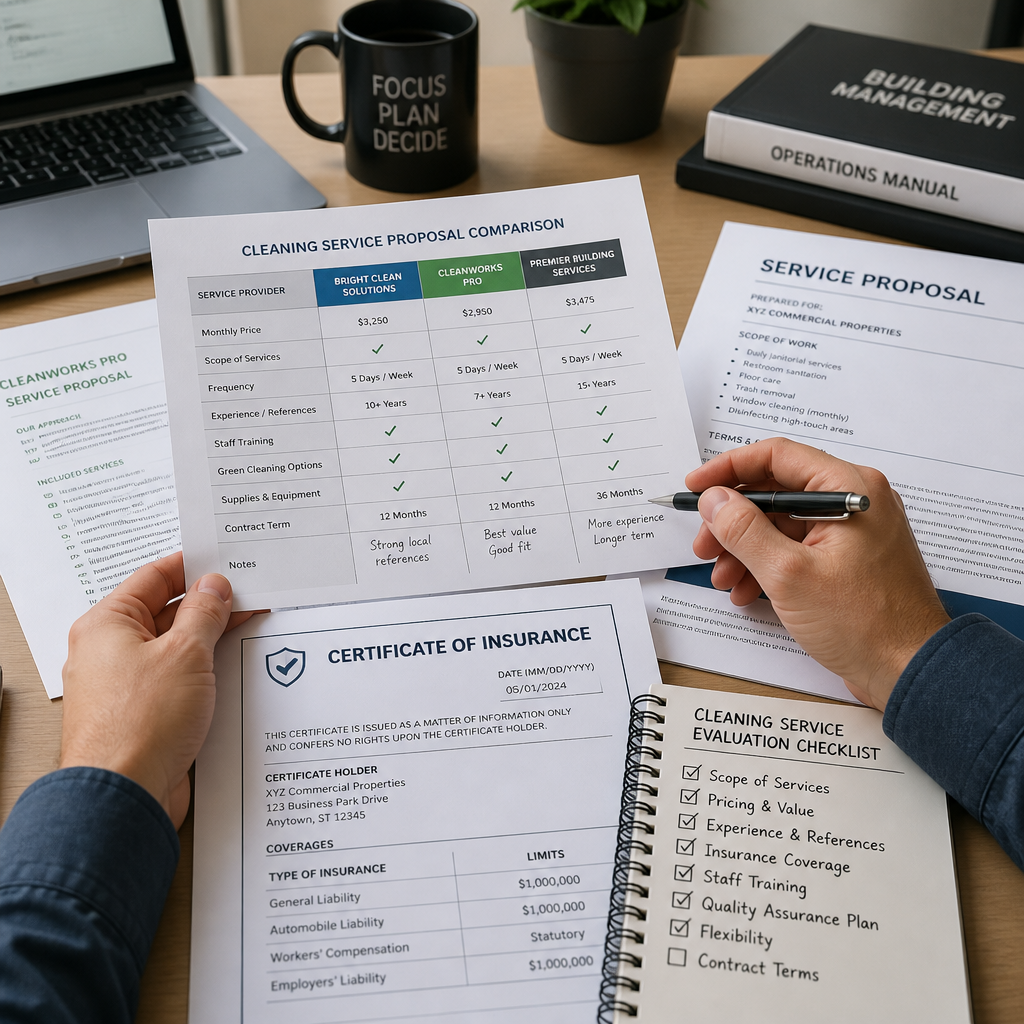
Any quote worth comparing should specify: the tasks included per visit, the frequency of each task, the products or methods used, the number of hours on site per visit, and which specialist services (carpet cleaning, window cleaning, floor stripping) are included versus quoted separately. Vague line items like “general cleaning” are a liability for clients. Demand specifics before accepting any price as accurate.
The Price Comparison Problem
If one quote is significantly below every other tender, something in the chain is being cut. Cleaning hours are reduced, products are diluted, staff are underpaid and therefore unmotivated, or the initial price is a loss leader that will be revised upward at contract renewal. Specialist services like carpet cleaning, floor stripping and sealing, or post-construction cleaning are priced differently based on area and condition. Always request a site-specific quote rather than accepting a phone estimate, as accurate pricing depends on your actual floor area, access conditions, and cleaning frequency.
Comparing Providers Across Models
| Provider Type | Typical Strengths | Common Weaknesses |
|---|---|---|
| National Franchise Networks (e.g., CrestClean, Jani-King) | Established brand systems, standardised training, wide coverage | Franchisee turnover disrupts consistency, complaints escalate slowly, multi-city accountability is split across different franchisees |
| Independent Owner-Operators | Competitive pricing, direct accountability to one person | No backup cover for illness, limited capacity, insurance often minimal, difficulty scaling |
| Established Mid-Sized Companies with Employed Staff (e.g., Triple Star Commercial Cleaning) | Consistent crew, single point of contact, employer-level accountability, capacity for multi-site and specialist services | Typically higher base price than sole traders, less name recognition than national franchise brands |
Pro tip: When comparing quotes across providers, build a simple scoring sheet that rates each provider on insurance documentation, sector experience, checklist detail, contract terms, and references. Price should be one column among several, not the deciding factor on its own.
What a Good Cleaning Contract Looks Like
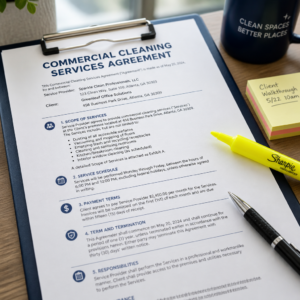
Most cleaning contracts are written to favour the provider. Before signing anything, review these elements carefully. A well-structured contract protects both parties and removes ambiguity about what you are paying for.
Scope of Work Must Be Itemised
The contract must describe exactly what will be cleaned, how often, and with what products or methods. Vague language like “general cleaning” is a liability for clients. Demand itemised tasks for each area of your site: workstations, bathroom fixtures, kitchen surfaces, floors, glass partitions, entry mats, bins, and any shared spaces. If a task is not listed in the contract, do not assume it will be done.
Substitution and Cover Procedures
Ask who cleans your site if the regular staff member is unavailable, and what the vetting process is for substitutes. A company that cannot answer this question clearly is telling you that your site will be left uncleaned, or handed to an unfamiliar person, when your regular cleaner is sick.
Exit Terms and Notice Periods
Most New Zealand commercial cleaning contracts include a minimum notice period of 30 to 90 days. Understand what happens at contract renewal: does the price automatically increase, and if so by how much? Contracts that roll over indefinitely without a fixed renewal review date tend to drift upward in price while service levels stay flat.
Performance Review Mechanisms
Ask prospective cleaners how they verify that standards are being met, not just assumed. Is there a site inspection process? How are complaints logged and resolved? A company that has no formal performance review mechanism is relying entirely on client complaints to catch problems, which means standards will slide between complaints.
Red Flags to Watch Before You Sign
These are the signals that consistently precede poor cleaning outcomes. Any one of them warrants further investigation. Two or more of them together is a reason to keep looking.
- Unwillingness to provide a current certificate of insurance with the insurer’s name and policy number.
- No cleaning checklist or inability to produce one for a comparable site.
- A quote significantly below all other tenders with no clear explanation of how costs are lower.
- Vague contract language that uses phrases like “general cleaning” without itemising tasks.
- No clear answer to the question: who covers your site if the regular cleaner is unavailable?
- References that are outdated, uncontactable, or drawn from a completely different sector.
- Remote quoting without a site visit, particularly for larger or more complex properties.
- Pressure to sign quickly before you have reviewed the contract terms in full.
Multi-City Operations: Christchurch and Auckland
If you manage commercial properties or facilities in both Christchurch and Auckland, the challenge is not just finding good cleaners in two places. It is building a system that delivers consistent outcomes without requiring constant supervision from your end.
The most common mistake property managers make is treating each city as a completely separate procurement exercise. This produces two unrelated suppliers, two different service standards, two sets of reporting, and twice the management overhead. The better approach is to find a provider with genuine operational capacity in both cities, meaning local staff and local management in each location, not a single head office managing crews remotely across both centres.
Christchurch: Local Market Characteristics
Schools are a significant cleaning client category in Christchurch, and the city’s commercial centre is compact enough that route efficiency for cleaning companies is generally better than in Auckland’s sprawling geography. When evaluating a supplier for a Christchurch site, ask specifically about their school and medical centre experience. These are among the most demanding environments in the city in terms of hygiene and scheduling requirements, and a supplier with real experience in both will handle a standard commercial office without difficulty.
Auckland: Multi-Site Complexity
Auckland’s commercial cleaning market is larger and more fragmented than Christchurch’s. The city’s geography, spread across multiple distinct business districts including the CBD, Newmarket, Botany, and the North Shore, means that a cleaning company with genuine Auckland capacity needs real operational presence across those areas, not just a phone number with an Auckland area code. When evaluating Auckland providers, confirm specifically which suburbs and districts they service directly with their own staff, and which areas they would cover with subcontractors.
Triple Star Commercial Cleaning operates directly in both Christchurch and Auckland with locally based teams and local management, which addresses the multi-city accountability gap that property managers frequently encounter with franchise-based providers.
Frequently Asked Questions
What is the minimum insurance level I should require from a commercial cleaning company in New Zealand?
Public liability insurance is the minimum requirement before letting any commercial cleaner onto your premises. The minimum acceptable level for a commercial site in New Zealand is typically $1 million, though $2 million is increasingly standard for larger sites. Always request a current certificate of currency with the insurer’s name and policy number, not just a verbal confirmation. If you are engaging specialist services such as carpet cleaning, floor stripping, or flood restoration, confirm those are covered under the same policy.
What is the difference between a cleaning franchise and a company with directly employed staff?
In a franchise model, the person cleaning your site is an independent franchisee, not a direct employee of the brand you hired. This can mean inconsistent staff, changes to your cleaning crew without notice, and complaints that take longer to resolve because they pass through a franchisor. A company with directly employed staff gives you a named contact, a consistent crew, and an employer-level obligation to maintain standards. For sites where continuity matters, such as medical centres, schools, and multi-tenanted buildings, direct employment is the more reliable structure.
How should I compare cleaning quotes when prices vary significantly?
Do not compare headline weekly prices in isolation. Compare what each quote includes: tasks per visit, hours on site, frequency, products used, and which specialist services are included versus priced separately. A quote significantly below all others almost always involves a reduction in cleaning hours, product quality, or staff pay rates. Build a scoring sheet that rates each provider on insurance, sector experience, checklist detail, contract terms, and references, and weight price as one factor among several rather than the deciding one.
Do I need a different cleaning provider for Christchurch and Auckland if I manage properties in both cities?
Not necessarily, but you should confirm that any provider you choose has genuine operational capacity in both cities, meaning local staff and local management in each location. A company with a single head office managing crews remotely across both cities will struggle to respond quickly to site-specific issues. The best outcome for multi-city property managers is a single provider with real local presence in both Christchurch and Auckland, which eliminates split accountability and inconsistent service standards.
What questions should I ask about staff vetting before allowing a cleaning company onto my site?
Ask about the company’s staff vetting process before signing any contract. Reputable operators run background checks on staff before granting them access to client premises, which is particularly important for sensitive environments like schools, medical centres, and government buildings. Ask whether vetting requirements are confirmed in writing, and ask specifically about the process for substitute cleaners who may cover your site when regular staff are unavailable. A company that cannot clearly explain its substitution and vetting procedures is a risk for sites with security or hygiene requirements.
What should a commercial cleaning contract include to protect me as a client?
The contract should itemise exactly what will be cleaned, how often, and with what methods or products. Vague language like “general cleaning” is not sufficient. It should specify the tasks for each area of your site, the notice period required to exit, the process for raising and resolving complaints, and any automatic price review clauses at renewal. Ask specifically about cover arrangements when regular cleaning staff are unavailable, and confirm that the performance review process is built into the contract rather than left to informal communication.
If you manage commercial properties or facilities in Christchurch or Auckland, share your experience below: what factor mattered most when you chose your current cleaning provider, and what would you do differently?
References
- New Zealand commercial cleaning industry guide covering insurance, vetting, and provider selection criteria
- Commercial cleaning compliance requirements in New Zealand including HSWA obligations and insurance standards
- Legal guidance on commercial cleaning contracts and employment structures in New Zealand
- RNZ investigation into commercial cleaning franchise models and franchisee concerns in New Zealand
- Staff vetting, insurance requirements, and selection criteria for commercial cleaning companies in New Zealand