Most property managers and business owners treat carpet cleaning as a box-ticking exercise. They schedule it once a year, the team shows up, the carpets look a shade lighter, and everyone moves on. That approach is costing you more than you realise. Commercial carpet cleaning in Christchurch is not just about appearances. It directly affects indoor air quality, staff health, client impressions, and the lifespan of a flooring asset that costs thousands to replace. If you manage an office, medical centre, school, or retail space, this article is written specifically for you.
Table of Contents
- Quick Takeaways
- Why Commercial Carpet Cleaning Is Different From Residential
- The Real Cost of Neglected Carpets in Commercial Spaces
- Cleaning Frequencies by Sector: What Actually Works
- Hot Water Extraction vs Dry Cleaning: Which Method Is Right
- Carpet Cleaning Method Comparison
- Upholstery Cleaning in NZ: The Overlooked Partner to Carpet Care
- Carpet Cleaning Auckland vs Christchurch: Regional Considerations
- What to Look for in a Commercial Carpet Cleaner
- Frequently Asked Questions
- References
Quick Takeaways
| Key Insight | Explanation |
|---|---|
| Carpet holds up to four times its weight in dirt | Commercial carpet acts as a filter, trapping dust, bacteria, and allergens until it is professionally extracted. Vacuuming alone does not remove embedded contaminants. |
| High-traffic areas need cleaning every 3 to 6 months | Waiting 12 months between professional cleans in busy offices or retail stores allows fibre damage and staining that becomes permanent. Frequency matters more than intensity. |
| Dirty carpets affect staff health and productivity | Research links poor indoor air quality to increased sick days. Carpets in offices and medical centres are a primary reservoir for airborne allergens and bacteria. |
| Hot water extraction outperforms dry cleaning for deep contamination | For commercial spaces with embedded soiling, hot water extraction removes significantly more bacteria and allergens than surface dry-cleaning methods. |
| Upholstery and carpet should be cleaned on the same schedule | Cleaning carpets while leaving office chairs and soft furnishings dirty reintroduces contaminants immediately. Both surfaces need to be treated together. |
| Professional cleaning extends carpet lifespan by years | Regular professional maintenance can extend commercial carpet life from 7 years to 12 or more, deferring costly replacement budgets for property managers. |
| Liability and compliance matter in medical and school environments | Facilities like medical centres and schools have hygiene obligations. Using an insured, approved supplier protects the organisation from liability claims. |
Why Commercial Carpet Cleaning Is Different From Residential
Commercial carpet takes a fundamentally different level of punishment than carpet in a home. A busy Christchurch office with 50 staff members generates foot traffic equivalent to a large residential property in a single morning. Add delivery staff, clients, couriers, and contractors, and you are looking at carpet that accumulates soil at a rate most building managers genuinely underestimate.
The carpet specifications also differ. Commercial broadloom is typically denser and lower-pile to handle traffic, but that density means soil embeds deeper and is harder to dislodge. Residential cleaning methods applied to commercial carpet consistently underperform, which is why businesses that hire domestic cleaners for their commercial spaces often end up with damp, half-cleaned carpet that re-soils quickly.
In practice, the difference between a residential and commercial clean is not just equipment power. It is dwell time, chemical selection, extraction pressure, and drying speed. A proper commercial carpet clean uses truck-mounted or industrial portable hot water extraction systems that residential operators do not carry. The pre-treatment of heavily trafficked lanes, the correct dilution ratios for commercial-grade carpet shampoo, and the post-cleaning grooming all require practitioner knowledge that goes beyond operating a hire machine from the hardware store.
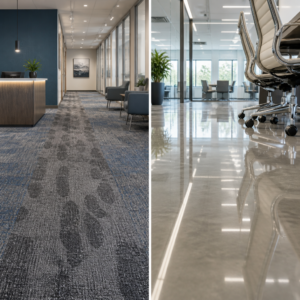
Pro tip: If your office carpet is showing grey traffic lanes down the main walkways, that is not just dirt. That is fibre abrasion caused by grit grinding against the carpet pile. At that stage, cleaning can restore colour but cannot reverse physical fibre damage. Earlier intervention prevents this entirely.
The Real Cost of Neglected Carpets in Commercial Spaces
Commercial carpet replacement in New Zealand is expensive. Depending on the quality and area, a mid-grade commercial carpet installation for a medium-sized Christchurch office runs between $8,000 and $25,000 when you factor in materials, installation, and business disruption. That is a significant capital expenditure that most property managers would prefer to defer as long as possible.
Regular professional cleaning is the single most effective way to extend carpet life. The Institute of Inspection, Cleaning and Restoration Certification (IICRC) recommends professional hot water extraction for commercial carpet at intervals of 6 to 12 months depending on traffic. Properties that follow this schedule routinely achieve carpet lifespans of 12 to 15 years. Properties that skip maintenance cleans typically replace carpet within 6 to 8 years.
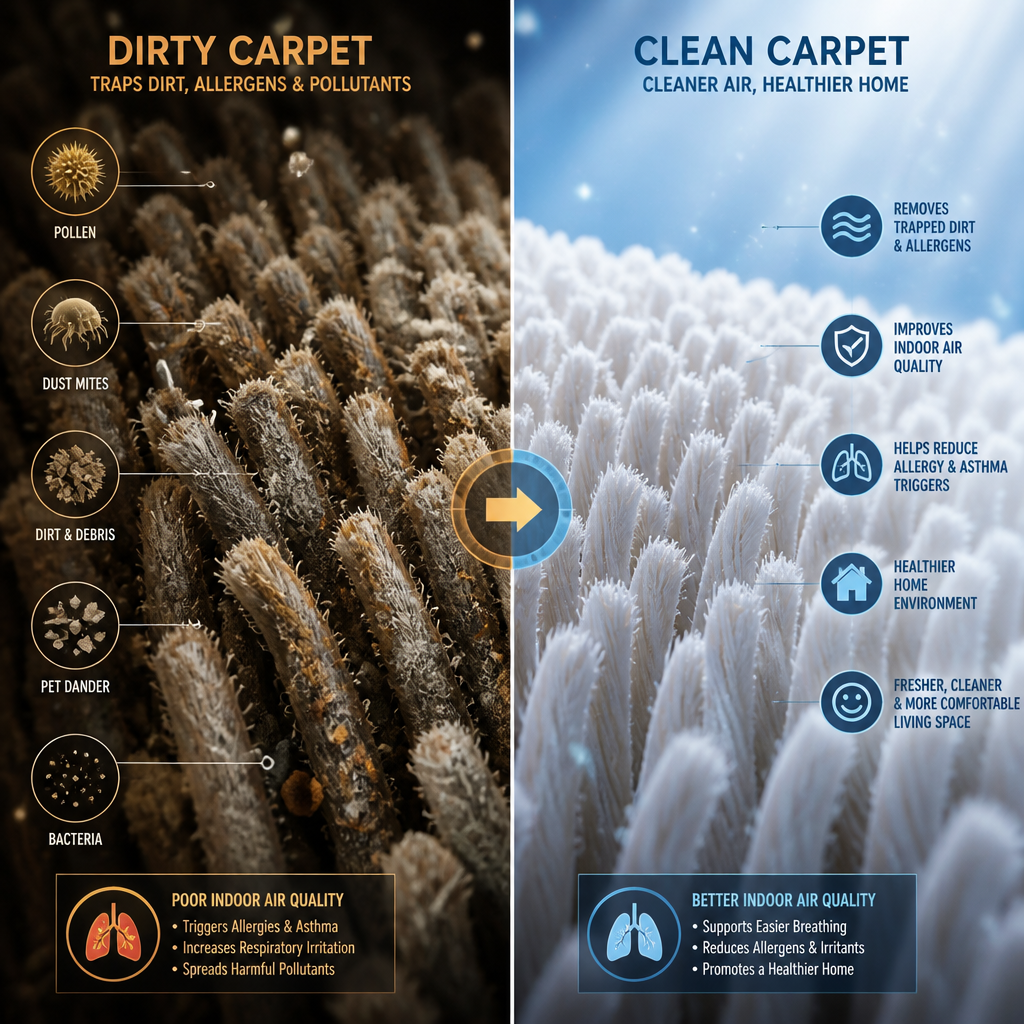
Beyond replacement costs, there is the indoor air quality argument that deserves more attention. The United States Environmental Protection Agency has documented that indoor air can be 2 to 5 times more polluted than outdoor air, with carpet acting as a primary reservoir for dust mites, mould spores, pet dander, and bacteria. In a Christchurch office or Auckland medical centre, that translates directly into staff sick days and potential complaints from clients or patients.
A common mistake is assuming that vacuuming daily solves the contamination problem. It does not. Vacuuming removes surface debris but does not extract the fine particulate and biological material embedded in carpet backing. Only hot water extraction or a comparable deep-cleaning method achieves that.
“Carpet acts as a passive air filter, trapping particles that would otherwise remain airborne. But like any filter, it must be cleaned regularly to continue functioning effectively rather than becoming a source of pollution itself.” – Institute of Inspection, Cleaning and Restoration Certification (IICRC), S100 Standard for Professional Carpet Cleaning
For retail stores in Christchurch and Auckland, there is also a direct commercial impact. Research published by the International Facility Management Association consistently shows that building cleanliness ranks among the top three factors influencing customer perception of a business. Stained, odorous, or visibly dirty carpet is a subconscious signal to customers that a business lacks attention to detail.
Cleaning Frequencies by Sector: What Actually Works
There is no universal answer to how often commercial carpet should be professionally cleaned, but there are clear guidelines based on sector and traffic levels. Generic advice to clean once a year is almost always insufficient for high-use commercial environments.
Offices and Commercial Buildings
A standard office with moderate foot traffic should schedule professional carpet cleaning every 6 to 12 months. High-traffic zones including reception areas, corridors, and meeting rooms near the entry should be cleaned every 3 to 4 months. Spot-treatment protocols between full cleans are essential to prevent stains from setting permanently.
Medical Centres and Healthcare Facilities
Medical environments in Christchurch and Auckland operate under stricter hygiene requirements. Professional carpet cleaning every 3 months is the minimum for waiting rooms and corridors. Some medical facilities opt for hard flooring in clinical areas precisely because carpet cleaning requirements are demanding. Where carpet is retained, the cleaning chemicals used must comply with infection control standards, which requires a supplier who understands healthcare environments.
Schools and Educational Facilities
Schools generate high traffic from children who bring in outdoor soil, food debris, and the biological matter that accompanies large groups of young people in close proximity. Term-based cleaning is the standard approach: professional extraction cleaning at the end of each school term ensures that accumulated contaminants do not compound over the full academic year. Triple Star Commercial Cleaning works with schools across Christchurch and Auckland on exactly this schedule.
Retail Stores
Retail carpet near entry points needs attention every 2 to 3 months during winter when wet weather tracking is at its worst. In Christchurch particularly, the combination of cold, damp winters and heavy foot traffic from shopping precincts means retail carpet deteriorates fastest between May and September.
Pro tip: Ask your cleaning provider to do a traffic-zone assessment before quoting. A flat quote for the whole floor area treats a low-use back office the same as a high-traffic reception area. A zone-based schedule saves money and puts cleaning effort where it is actually needed.
Hot Water Extraction vs Dry Cleaning: Which Method Is Right
This question comes up constantly from facility managers, and the answer depends on what you are trying to achieve and the operational constraints of your building.
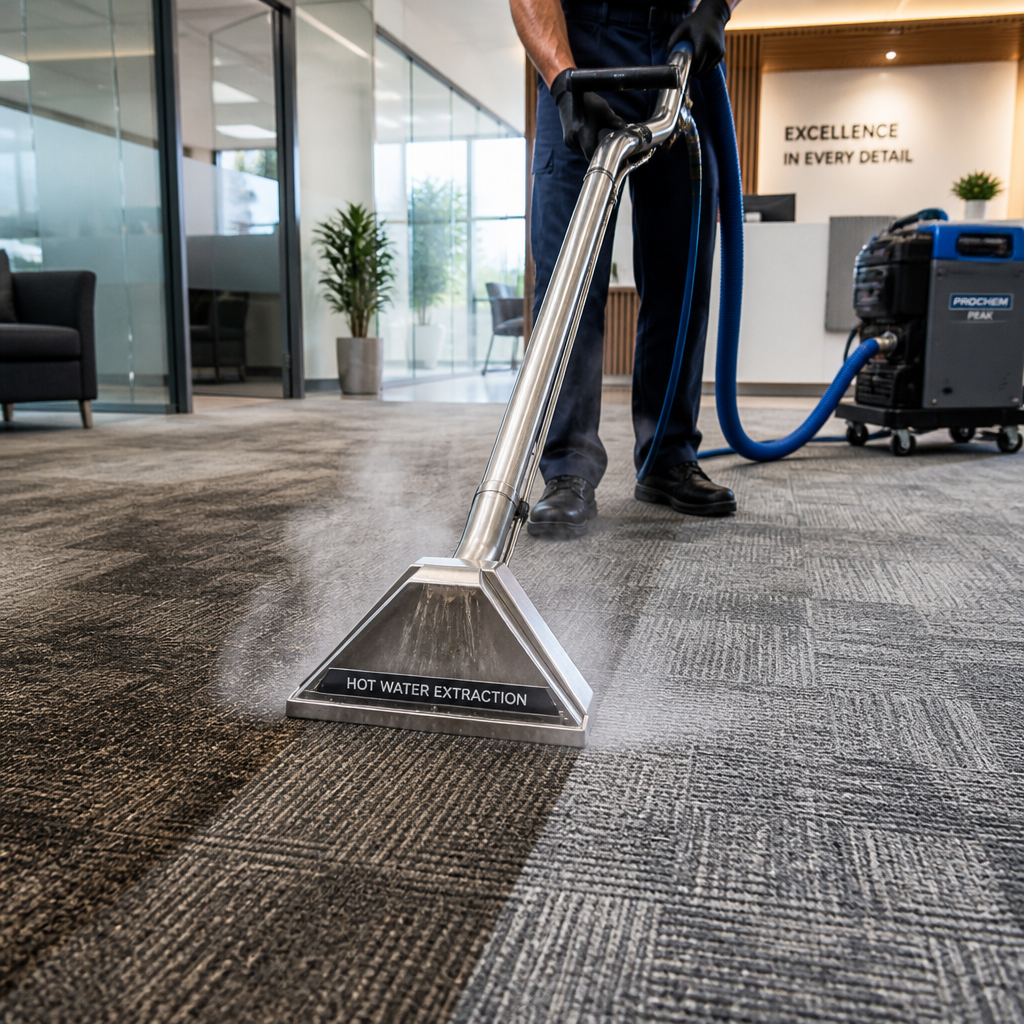
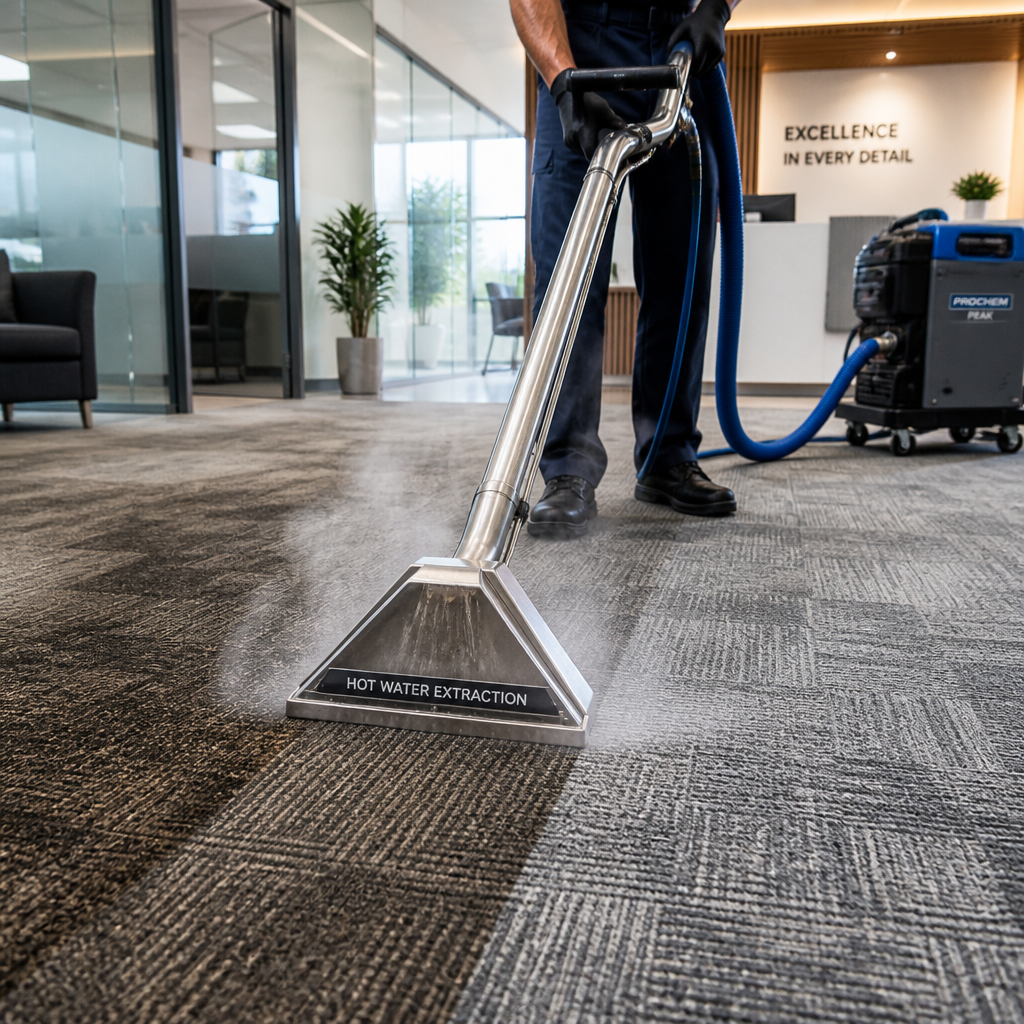
Hot water extraction, often incorrectly called steam cleaning, injects hot water mixed with cleaning solution into the carpet pile under pressure and immediately extracts it along with loosened soil. It is the most thorough deep-cleaning method available for commercial carpet and is the method recommended by most major carpet manufacturers for maintaining warranty compliance.
Dry cleaning methods, including encapsulation and dry compound cleaning, use minimal moisture and allow faster return to use. For spaces that cannot afford significant drying time, these methods offer a practical middle ground, though they do not achieve the same depth of extraction.
Carpet Cleaning Method Comparison
| Method | Best Use Case | Limitations |
|---|---|---|
| Hot Water Extraction | Deep cleaning for offices, medical centres, schools, and post-construction cleaning. Best for heavily soiled or allergen-loaded carpet. | Requires 2 to 6 hours drying time. Needs to be scheduled around business hours or after closing. |
| Encapsulation Dry Cleaning | Maintenance cleans between deep extractions for retail stores and high-traffic corridors where fast return to use is essential. | Does not remove deeply embedded soiling or biological matter. Not a substitute for periodic hot water extraction. |
| Bonnet Cleaning | Surface soil removal in low-pile commercial carpet for appearance maintenance only. | Pushes soil deeper into the pile rather than extracting it. Not recommended as a primary cleaning method for commercial environments. |
In practice, the best commercial carpet cleaning programs combine methods. Hot water extraction is used for quarterly or biannual deep cleans, with encapsulation maintenance cleans scheduled in between to keep high-traffic areas presentable. This hybrid approach delivers the best outcome for both hygiene and appearance without requiring the building to be offline for a full day every month.
Upholstery Cleaning in NZ: The Overlooked Partner to Carpet Care
Businesses that invest in commercial carpet cleaning and ignore office upholstery are solving half the problem. Upholstery cleaning in NZ commercial settings is consistently undervalued, yet office chairs, reception sofas, meeting room seating, and soft partitioning panels carry a similar contamination load to carpet.
Consider a typical Christchurch open-plan office. Staff sit in fabric chairs for 8 hours a day, 5 days a week. Skin cells, hair, food particles, and bacteria accumulate in the fabric at a significant rate. The average office chair that has never been professionally cleaned harbours bacterial counts that would be unacceptable on any food preparation surface. This is not alarmism. It is a documented characteristic of fabric upholstery in office environments.
The practical argument for combining carpet and upholstery cleaning is straightforward. If a professional cleaning crew is already on-site extracting carpets, adding an upholstery clean to the scope adds modest time and cost while eliminating the recontamination problem. Clean carpet and dirty chairs simply means the chairs reintroduce contaminants the moment staff sit down. Triple Star Commercial Cleaning offers combined carpet and upholstery cleaning services across both Christchurch and Auckland, which is the most efficient way to achieve a genuinely clean commercial environment.
For medical centres and healthcare facilities in particular, upholstery in waiting rooms needs to be treated with antimicrobial solutions that are specific to healthcare environments. Standard domestic upholstery cleaning products are not appropriate in these settings, which is why sector-specific knowledge in a cleaning provider matters.
Carpet Cleaning Auckland vs Christchurch: Regional Considerations
New Zealand’s two main commercial markets have different conditions that affect carpet cleaning needs, and a provider operating across both cities needs to understand these differences rather than applying a one-size-fits-all approach.
Christchurch has a colder, drier climate than Auckland for most of the year, but the wet winter months from May to August bring significant mud and moisture tracking into commercial buildings. Post-earthquake rebuild activity also means post-construction carpet cleaning is a recurring requirement in the city, with builders cleaning and new-build commercial fits requiring professional carpet preparation before tenant occupation. Triple Star has operated in Christchurch since 2015 and has direct experience with the dust and residue profiles that construction-related carpet contamination creates.
Auckland’s humidity is higher year-round, which creates a different risk profile. Carpet in Auckland commercial buildings is more susceptible to mould and mildew development if it is not dried quickly after cleaning or if moisture enters from flooding or plumbing issues. Carpet cleaning in Auckland for medical centres and schools needs to account for this, with faster-drying methods or dehumidification support in humid conditions. Triple Star’s Auckland operations include flood restoration services alongside routine carpet care, which means the team understands moisture management at a level that a general domestic cleaner does not.
Body corporate managers and property managers overseeing commercial buildings in both cities share one common challenge: coordinating carpet cleaning across tenanted spaces without disrupting business operations. This requires a provider with flexible scheduling, clear communication, and the capacity to work after hours or on weekends. That is exactly the operational model Triple Star uses across both markets.
What to Look for in a Commercial Carpet Cleaner
Not all commercial cleaning companies are equally equipped to handle carpet care in a professional context. The market includes operators who are competent at daily office cleaning but lack the equipment or training to deliver genuine commercial-grade carpet extraction.
The data consistently shows that businesses that choose the cheapest available option for carpet cleaning end up paying more in the medium term, either through premature carpet replacement, persistent odour and staining, or health-related complaints from staff or clients.
Insurance and Compliance Credentials
Any commercial carpet cleaning provider working in your building should carry public liability insurance. This is non-negotiable. If a cleaning contractor damages flooring, furniture, or causes a slip hazard from improper drying, you need the confidence that their liability cover protects your business. Triple Star Commercial Cleaning carries public liability insurance across all cleaning sites and is an UpstreamNZ approved supplier, which provides an additional layer of accountability for procurement teams and property managers.
Equipment Standards
Ask specifically whether the company uses truck-mounted extraction equipment or industrial portable units. Consumer-grade hire machines from hardware stores do not generate the water pressure or suction required for genuine commercial deep cleaning. The difference in result is visible and measurable.
Sector-Specific Experience
A company that cleans residential properties almost exclusively is not the right choice for a hospital waiting room or a school gymnasium. Sector experience matters because chemical selection, drying requirements, and compliance expectations differ significantly between environments. Ask for references from clients in your sector before committing to a provider.
Pro tip: When evaluating commercial carpet cleaning quotes, ask the provider to specify the extraction method, the pre-treatment process, expected drying time, and whether they carry public liability insurance. A provider who cannot answer these questions clearly is not operating at a professional commercial standard.
Frequently Asked Questions
How often should commercial carpet be professionally cleaned in a Christchurch office?
For a medium-traffic office environment, professional hot water extraction every 6 months is a reliable baseline. High-traffic zones such as reception areas and main corridors benefit from cleaning every 3 to 4 months. During Christchurch’s winter months, tracking from wet weather accelerates soiling rates, so many facility managers in the city schedule an additional maintenance clean between May and August.
What is the difference between steam cleaning and hot water extraction for commercial carpet?
These terms are often used interchangeably but they describe the same process. Hot water extraction injects hot water and cleaning solution into the carpet pile under pressure and extracts the mixture along with loosened soil and contaminants. No actual steam is involved. It is the most effective method for removing embedded soil, allergens, and bacteria from commercial carpet and is the method recommended by most major commercial carpet manufacturers.
Can commercial carpet cleaning be scheduled outside business hours?
Yes, and for most commercial environments it should be. Cleaning during business hours creates drying hazards, disrupts staff, and limits the area that can be cleaned at one time. Triple Star Commercial Cleaning operates flexible scheduling across Christchurch and Auckland, including after-hours and weekend services, specifically to accommodate businesses that cannot afford daytime downtime.
Is upholstery cleaning necessary at the same time as carpet cleaning?
Combining both is strongly recommended for any office or commercial space. Carpets and fabric upholstery accumulate similar contaminants. Cleaning the carpet while leaving chairs and soft furnishings untreated means those surfaces reintroduce bacteria and allergens to the freshly cleaned carpet immediately. A combined carpet and upholstery clean is more cost-effective than two separate visits and delivers a genuinely clean indoor environment rather than a partially clean one.
What should I do to prepare a commercial space for professional carpet cleaning?
Clear loose items from the floor, relocate portable furniture where possible, and ensure the cleaning crew has access to power points and water. Notify staff that areas will be wet and identify a dry-access route if the building needs to remain operational during the clean. Your cleaning provider should give you a pre-visit checklist. If they do not, that is a signal to ask more questions about their process.
Does professional carpet cleaning remove mould from commercial carpet?
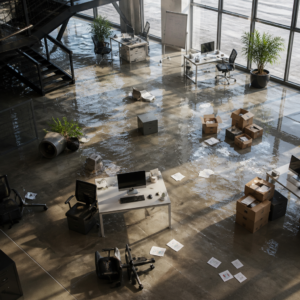
Professional hot water extraction combined with antimicrobial treatment can address surface mould in commercial carpet. However, if mould has penetrated the carpet backing or the underlay, extraction cleaning alone is insufficient. In those cases, the affected sections typically need to be removed and replaced. This situation arises in Auckland commercial buildings more frequently due to higher ambient humidity, and is also a common post-flood scenario that requires restoration-grade intervention rather than standard cleaning.
How do I know if a commercial carpet cleaning company is reputable in Christchurch or Auckland?
Ask for proof of public liability insurance, check whether they are affiliated with approved supplier networks, and request references from businesses in a similar sector to yours. Reputable commercial cleaners are transparent about their equipment, their methods, and their compliance credentials. Triple Star Commercial Cleaning is an UpstreamNZ approved supplier and all sites are covered by public liability insurance, which is the standard of accountability that commercial property managers should require from any cleaning provider.
If you manage a commercial property in Christchurch or Auckland, we would like to hear what your biggest challenge has been with carpet maintenance. Share your experience below.
References
- United States Environmental Protection Agency, research and guidance on indoor air quality and carpet as a contaminant reservoir
- Statista, facility management and commercial cleaning industry data for market size and service frequency benchmarks
- Forbes, commercial real estate and facility management insights on building maintenance and tenant satisfaction
- Institute of Inspection, Cleaning and Restoration Certification, professional standards and technical guidance for commercial carpet cleaning methods
- New Zealand Ministry of Health, guidelines on infection control and hygiene standards relevant to healthcare and educational facilities