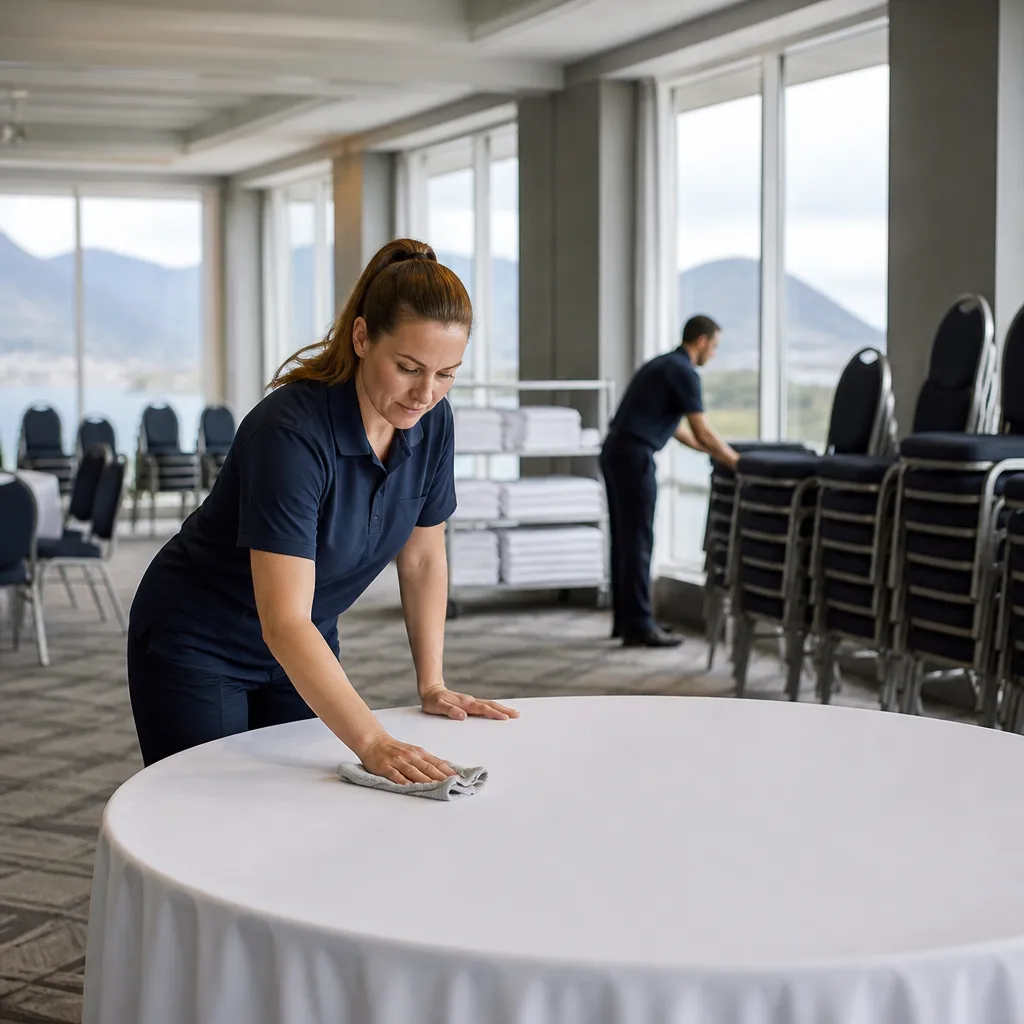
A venue can look finished at six in the evening and still fail the next client at eight the next morning. When event venues run back-to-back bookings in Auckland and Christchurch, the gap between one function and the next is where most cleaning problems start: sticky tables left from a gala dinner, a washroom that never got its second restock, or a stage area nobody swept before the next production crew arrived. Event venue cleaning NZ managers are judged on how fast they can reset a room, not only on how it looked on the night. This guide covers what a between-booking cleaning plan needs, how to time it, and where plans usually break down.
Table of Contents
- Quick Takeaways
- Why Turnaround Is the Real Test
- Building the Between-Booking Checklist
- Scheduling the Reset Around Bump-In and Bump-Out
- Washrooms, Catering Areas and Spill Response
- Comparing Three Turnaround Approaches
- Contracts, Insurance and Choosing a Cleaning Partner
- Frequently Asked Questions
- References
Quick Takeaways
| Key Insight | Explanation |
|---|---|
| Fix the turnaround window before the booking is signed | Once the client has committed, the window is hard to change. Write the time the room must be clear, the time cleaning starts, and the time set-up can begin into the booking terms. |
| Split the reset into a dry pass and a wet pass | Clear waste and debris first, then wet-clean floors and surfaces. Mopping before the bins are emptied spreads grime and wastes the crew’s time. |
| Restock washrooms during the event, not only after it | Dispensers and bins run out at peak times. A midday check stops the next full reset from starting with problems that should have been handled during the function. |
| Treat bars and catering stations as a live cleaning task | Wipe spills as they happen and empty drip trays during service. These tasks take minutes during an event and hours at the reset. |
| Check food safety obligations before setting catering cleaning schedules | If food is prepared or served on site, confirm which Ministry for Primary Industries food safety rules apply, then build the cleaning schedule to match. |
| Write down what “handover ready” means | A room card with layout, bin points, washroom locations, and a photo of the standard stops the next crew from guessing what the last client expected. |
| Confirm insurance and supplier approval before work starts | Ask for public liability cover in writing and confirm it applies to your site. Check any supplier approval status as part of the same check. |
Why Turnaround Is the Real Test
Published venue cleaning guides tend to describe post-event cleaning as the work that restores a space to handover condition after guests leave. That means waste removal, washroom resets, floor cleaning, and back-of-house checks. For a venue manager, the more useful question is how long the team has between one client leaving and the next one arriving, because that window sets what can realistically be done.
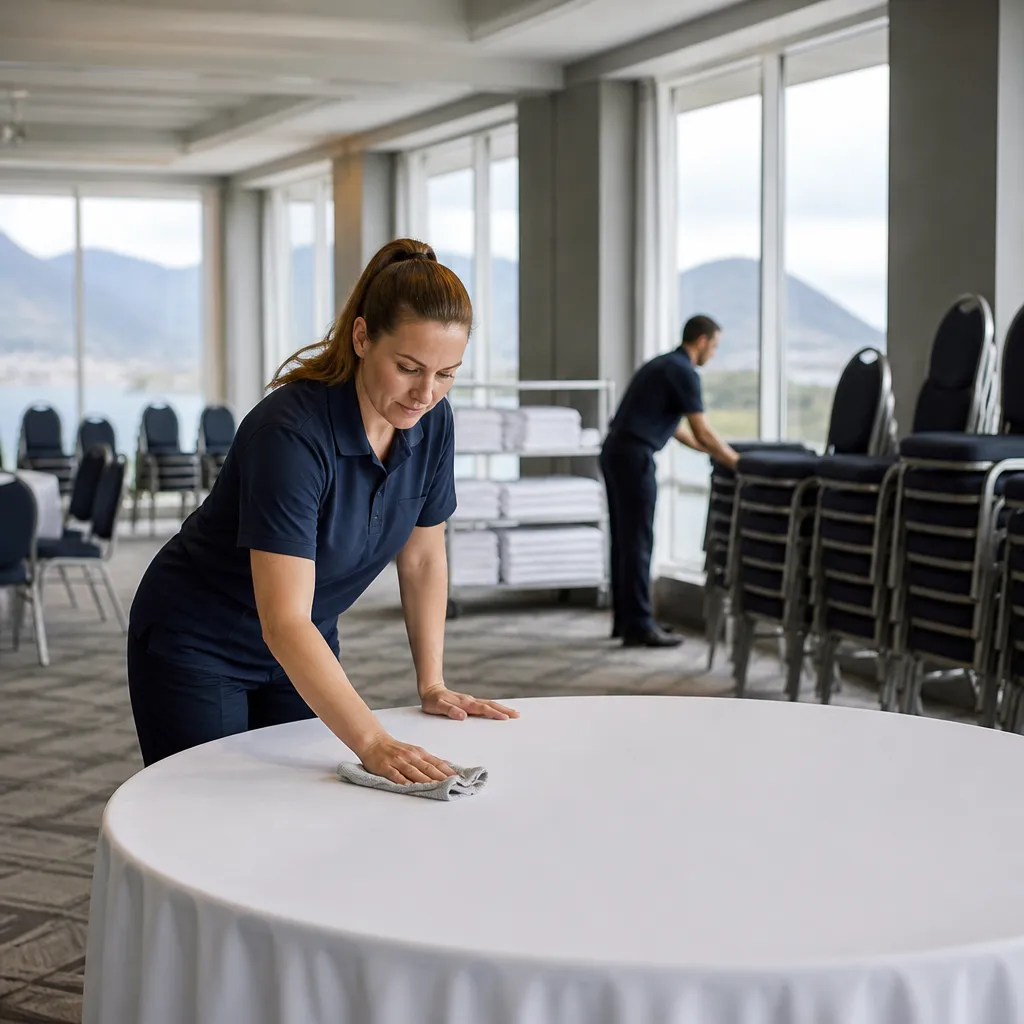
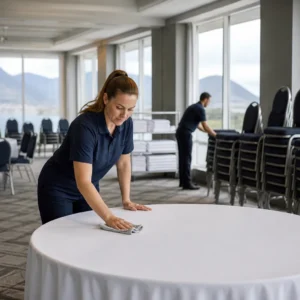
In practice, the window is often shorter than managers expect. A function may finish late, the client’s team may still be collecting props, and the next group may be booked for a breakfast, a conference session, or a set-up that starts before the room has been cleared. When the reset is squeezed, the cleaning tends to skip the things guests notice last, such as dusty skirting boards, marked carpet near the bar, or a half-cleaned washroom.
What handover condition actually means
Handover condition is a standard you agree before the work starts, not a feeling at the end of the shift. For a conference room, it may mean chairs wiped, carpet vacuumed, and no food residue on the tables. For a hall with a stage, it may also mean the stage edges are swept and cable runs are cleared. If the standard is not written down, the cleaner and the venue manager will each assume the other has checked the room.
The hidden cost of a rushed reset
A rushed reset rarely fails in one obvious place. It fails at the edges: under tables, behind doors, and in the corner nearest the kitchen pass. Those spots generate complaints from the next client, and they cost the most to fix later, because stains set and grime builds. A small extra stretch of time at the right point in the turnaround usually costs less than a deep clean booked after the next client has already complained.
A room is only as ready as its least-checked corner, and between bookings that corner is usually the one nobody walked into after the last function.
Pro tip: Walk the room with the next client’s event coordinator, or with photos of the agreed handover standard, before the cleaning crew starts. Agreeing on what “ready” looks like removes most arguments at handover.
Building the Between-Booking Checklist
A workable checklist starts with the order of work, not the list of tasks. Published checklists for venues and exhibition spaces commonly sort work into a timeline: pre-event setup, live support during the function, then a full reset before handover. Between bookings, you are usually working only the final stage, so the checklist needs to be short enough to finish inside the window and detailed enough that nothing essential gets skipped.
Start with the things that cannot wait: waste, floors, and washrooms. Those three areas drive most of what the next client sees and smells. Everything else can be ranked below them, so if time runs out, the crew knows what to drop without guessing.
Waste streams first
Clear the bins and bag the waste before anyone wipes a surface. Separate general waste, recycling, and food waste the way your venue contract requires, and make sure the bags leave the room before floor work starts. Bags left in the corridor are a common reason a turnaround runs late, because they block the route to the loading area.
Floors, furniture and soft surfaces
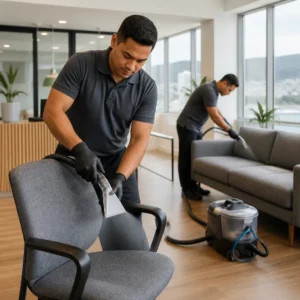
Do the dry pass first: vacuum or sweep to remove crumbs, confetti, and debris, then wet-clean hard floors. Soft surfaces need a separate decision. Spot cleaning chairs, upholstery, and carpet is often enough between functions, but a red wine spill or a food stain left overnight may need specialist treatment. Hard floors that have taken heavy traffic or sealant damage may need more than a mop, and that work belongs in your maintenance plan rather than the turnaround itself. Floor stripping and sealing is a good example of this kind of job.
Back-of-house and access routes
Check the routes staff and the next production crew will use: fire exits, loading bays, lifts, and corridors. A clear route is part of the handover standard. If back-of-house storage is still full of the last client’s stock, the next client has nowhere to put their equipment, and the room will look unfinished even if it is clean.
Scheduling the Reset Around Bump-In and Bump-Out
The biggest scheduling problem in event venues is overlap. The outgoing client is still removing equipment, the incoming client’s set-up team is already arriving, and the cleaning crew is trying to find a clear floor. A turnaround plan works only when everyone agrees on who has the room at each point on the clock.
Agree the window before the booking is confirmed
Write the turnaround window into the booking terms. State the time the room must be clear, the time the cleaning crew starts, and the time the incoming client can begin set-up. If the window is set after the booking is signed, the venue often ends up trading cleaning time for a bigger booking, and the cleaning gets compressed. An agreed window also gives you a basis for charging extra when a client runs over.
Who clears the room when production crews are still in it
Set a rule for shared space. For example, the cleaning crew can enter the floor area as soon as the stage and rigging are off the floor, while back-of-house areas and washrooms can be started earlier. Production crews are rarely hostile to cleaners, but they do tend to park cases and cables wherever they fit. The venue manager needs to decide where the clear zones are and enforce them.
Staffing for weekend and early-morning turnarounds
Many function bookings end late and the next one starts early, so turnarounds often fall overnight or on weekends. Plan staffing for those times in advance. A team that knows the room, the layout, and the handover standard will finish a reset faster than a new crew working from a note on the door.
Pro tip: Keep a one-page room card for each space, showing the layout, washroom locations, bin points, and the handover standard. It lets a new crew start in minutes rather than spending the first half hour finding things.
Washrooms, Catering Areas and Spill Response
Washrooms and catering areas shape how a venue is judged, and they are where a between-booking reset most often falls behind. A washroom cleaned at the start of a conference day can look and smell poor by mid-afternoon, and the next client will judge the whole venue on what they find when they walk in.
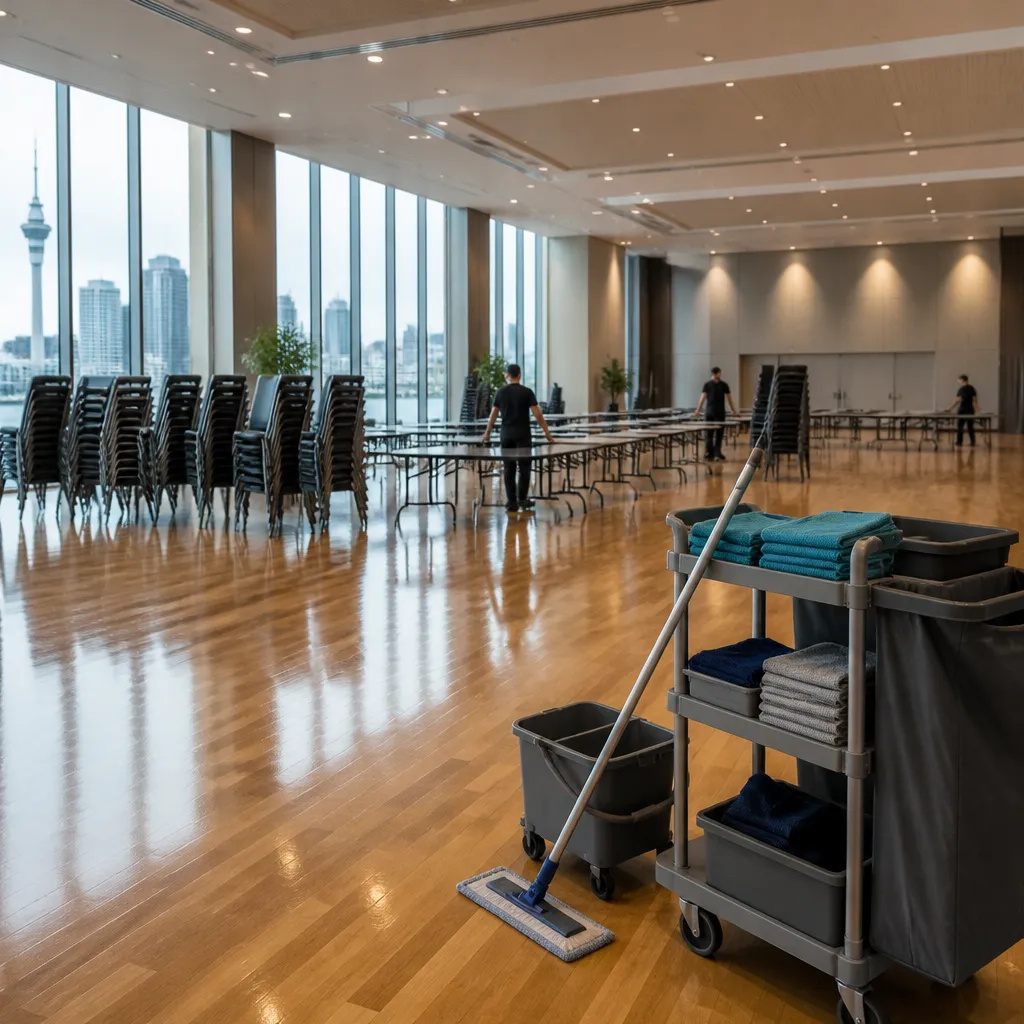
Washroom resets that hold up through a full day
Plan washroom work in two stages. The first is a full reset between bookings: clean and disinfect fixtures, empty and wipe bins, and restock paper, soap, and sanitary supplies. The second is a check during the event, which catches empty dispensers and overflowing bins before guests notice them. Published event checklists treat live washroom support as a separate task for this reason. Without a midday check, the next full reset starts with problems that should have been handled during the function.
Bars and catering stations
Sticky bars, damp counters, and drip trays are where spills turn into hazards and complaints. A published event cleaning checklist recommends wiping up spills immediately to prevent staining and slip hazards, and emptying drip trays as part of catering station cleaning. Those tasks take minutes during service and hours at the reset. If your venue hosts food, check which food safety rules apply to your operation through the Ministry for Primary Industries tool, since the cleaning schedule for a catering area may need to match those obligations.
Spill response during the event
Spills need a named person and a response time. Agree who handles them during service, what kit they carry, and how quickly the area must be made safe. Wet floor signage is a basic safety measure, but it only works when someone is actually responding to the spill. A venue that waits for the reset to deal with a spill has lost the stain battle, and may have created a slip risk for guests in the meantime.
Comparing Three Turnaround Approaches
Most venues choose between three ways of handling turnaround cleaning. Each works for some operations and fails for others, and the choice depends mostly on booking volume, room size, and how predictable the event calendar is.
| Approach | Best suited to | Main weakness |
|---|---|---|
| In-house housekeeping team | Venues with steady, predictable bookings and staff who can work outside standard hours | Holiday cover, sick leave, and peak weekends can leave the reset understaffed |
| Ad hoc callout cleaning | Smaller venues with occasional bookings and one-off cleaning needs | Crews often arrive without a room card or handover standard, so quality varies between visits |
| Scheduled turnaround contract with a professional cleaning company | Venues with regular or back-to-back functions that need the same handover standard every time | Requires a written scope and agreed windows, and the venue must keep the calendar accurate |
In practice, the in-house team works well until the calendar gets busy. The team knows the building, but when two functions fall on the same weekend, the reset is often the first task to be cut. Callout cleaning can look cheaper per visit, yet the venue pays for it in rework when the second crew cannot find the stock or the routes.
A scheduled contract suits venues where the same handover standard has to be met every time. The effort is the written scope, and that effort pays back once the reset becomes predictable. Triple Star Commercial Cleaning runs scheduled commercial cleaning in Christchurch and Auckland, and the same principles apply whichever provider you choose.
Contracts, Insurance and Choosing a Cleaning Partner
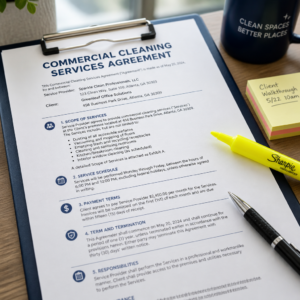
A turnaround plan is only as good as the document behind it. Whether the work is done in-house or by a contractor, the venue needs a written scope that says what happens between bookings, who signs off, and what counts as finished. Without that, every disagreement at handover becomes a question of memory.

What the agreement should specify
Include the turnaround window, the handover standard with photos where possible, waste and recycling arrangements, the washroom restock schedule during events, and the spill response time. Add an escalation route for the day a turnaround overruns, because it will happen. A short clause that says who decides whether to start the next set-up late or proceed with partial cleaning saves a lot of argument on the day.
Insurance and supplier approval
Ask every cleaning provider to confirm their public liability cover in writing, and confirm that the cover applies to the sites they will work on. Triple Star Commercial Cleaning covers all cleaning sites with public liability insurance and is an UpstreamNZ approved supplier, which are the kinds of details a venue manager should check for any provider. Some government agencies also buy cleaning through nationwide contracts, so if your venue has public sector clients, check whether any framework terms apply to the cleaning work.
Questions to ask before you sign
Ask how long a typical turnaround takes for a room of your size, how the crew is briefed on your handover standard, and what happens if the room is not ready when the next client arrives. Ask who the contact person is on the night and how quickly they respond. A clear answer to each of these tells you more than a long list of services.
Pro tip: Ask for a sample handover checklist from any provider before you commit. A specific, room-by-room checklist shows whether they understand events. A generic one usually means they will learn your venue on your time.
Frequently Asked Questions
How long should a between-booking clean take in a conference room?
There is no universal figure that fits every room, so build the window from your own space. Time a full reset during a normal week, add time for the walk-through and a buffer for overruns, and write that figure into the booking terms. Setting the window from real timings works far better than guessing one.
Do function rooms and washrooms need separate cleaning schedules?
Yes. Function rooms and washrooms have different tasks, different risks, and often different crew members. A single combined list tends to push washroom work to the end, when it is most likely to be rushed. Keep separate lists that are checked against the same handover standard.
How often should washrooms be checked during a multi-day event?
In our experience, washrooms should be checked at least once during each service session, plus a full check before the first guests arrive the next day. The midday check is the one most often skipped, and it is the one that stops dispensers running empty and bins overflowing before guests notice.
What food safety obligations should a venue check before setting a catering cleaning schedule?
If food is prepared, served, or stored on site, check which food safety rules apply to your operation with the Ministry for Primary Industries. The tool on their site helps you find the right plan or programme and where to register. Build your catering cleaning schedule to match those obligations rather than setting it from habit.
What insurance should a cleaning contractor hold for venue work?
At minimum, ask for public liability cover confirmed in writing, and check that it applies to the sites where the work will happen. Triple Star Commercial Cleaning covers all cleaning sites with public liability insurance, and it is worth asking any provider for the same confirmation before work begins.
Can floor stripping and sealing be done in the same turnaround as a normal reset?
Usually not. Floor stripping and sealing needs time for the floor to dry and cure before it can take traffic or furniture, so it does not fit a short between-booking window. Schedule it as a separate maintenance job in a planned gap, and keep the turnaround focused on waste, floors, washrooms, and handover checks.
What is the tightest turnaround window you have worked with, and which part of the reset gave you the most trouble?
References
- Post-event cleanup checklist covering pre-event, live support, and reset task order for venues
- Overview of pre-event, post-event, and maintenance venue cleaning services
- Event cleaning checklist covering catering stations, bars, and spill response
- Ministry for Primary Industries tool for finding the food safety rules that apply to a business