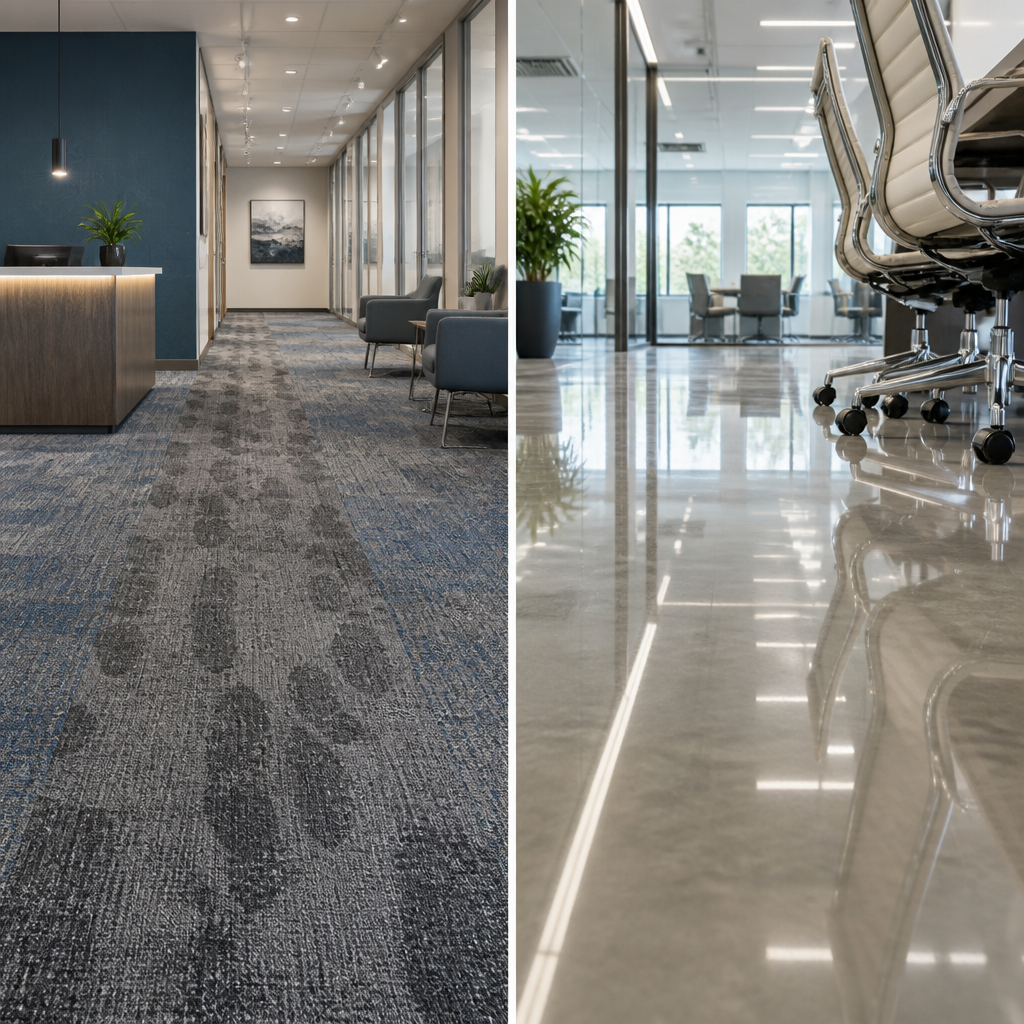
Most Auckland property managers treat commercial carpet cleaning and hard floor maintenance as the same problem with the same solution. They are not. The cleaning methods, scheduling, cost structures, and failure modes are completely different, and mixing them up is one of the most reliable ways to accelerate floor damage and inflate your cleaning budget at the same time. If your building has a mix of carpet and hard floor surfaces, and nearly every commercial property in Auckland does, you need a maintenance plan that treats each surface on its own terms. This guide covers exactly that.
Table of Contents
- Quick Takeaways
- Why Surface Type Changes Everything in a Commercial Setting
- Commercial Carpet Cleaning in Auckland: What the Schedule Actually Looks Like
- Hard Floor Maintenance in New Zealand: More Than Mopping
- Carpet vs Hard Floor: Side-by-Side Maintenance Comparison
- Office Floor Cleaning Zones: Matching the Method to the Traffic
- Common Mistakes Auckland Properties Make with Floor Maintenance
- Frequently Asked Questions
- References
Quick Takeaways
| Key Insight | Explanation |
|---|---|
| Traffic zones drive cleaning frequency, not floor area | A reception carpet in a busy Auckland office needs professional cleaning three times more often than a low-traffic admin area in the same building. |
| Hard floors fail silently before they fail visibly | Vinyl and sealed concrete lose their protective coating gradually. By the time a hard floor looks worn, stripping and resealing costs significantly more than timely maintenance would have. |
| Hot water extraction is the benchmark for commercial carpet | It removes embedded soil, allergens, and biological matter that surface cleaning methods cannot reach. Drying typically takes 4 to 12 hours in a well-ventilated commercial space. |
| Strip and seal intervals depend on floor type and use | Most commercial vinyl floors in moderate-traffic environments need stripping and resealing once or twice a year. High-traffic corridors and retail floors may need it more frequently. |
| Carpet acts as an air filter and has a saturation point | Once carpet fibres are saturated with particulates, the floor starts releasing contaminants back into the breathing zone rather than trapping them. Regular deep cleaning resets this cycle. |
| Medical centres and schools require the most frequent schedules | Carpeted areas in medical centres should be cleaned monthly. Retail carpet benefits from cleaning every one to three months depending on foot traffic levels. |
| Mixed-surface buildings need a single coordinated plan | Managing carpet and hard floor maintenance separately usually results in scheduling conflicts, missed intervals, and higher per-visit costs from your cleaning provider. |
Why Surface Type Changes Everything in a Commercial Setting
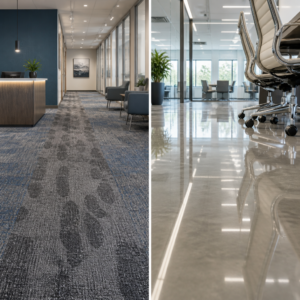
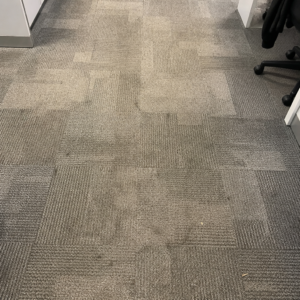
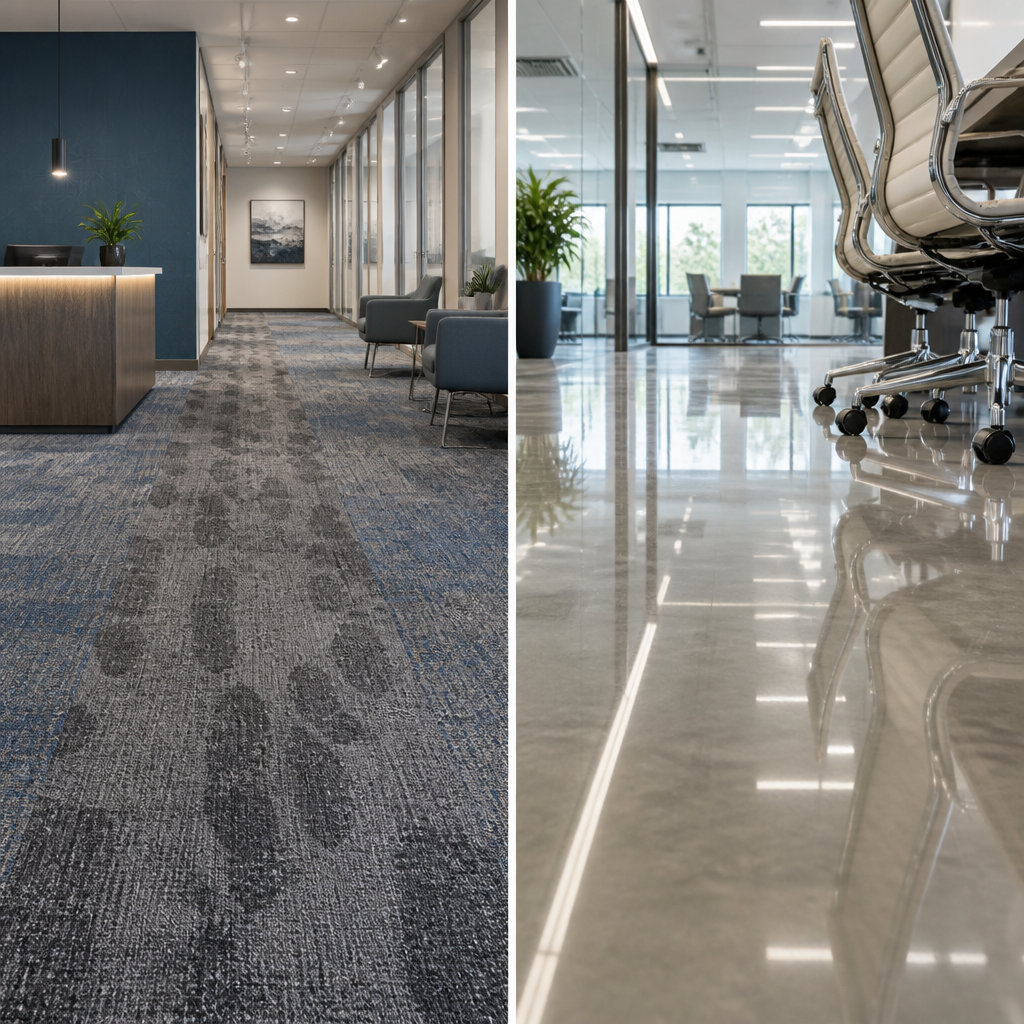
The first thing to understand is that carpet and hard floors do not fail in the same way. Carpet accumulates contamination deep in the pile, out of sight, while its surface can look clean long after it has become a reservoir for allergens, fine particulate matter, and biological material tracked in from outside. Hard floors, by contrast, show surface soiling immediately but degrade through coating wear, which is invisible until the floor is already compromised.
This difference matters enormously for property managers and facility teams. A carpet that looks acceptable is not necessarily clean, and a hard floor that looks dull is likely past the point where a simple mop and buff will fix it. Both surfaces require a professional eye and a schedule built around their actual maintenance needs, not around what is convenient to book.
For Auckland commercial properties, the practical reality is that most buildings combine both. Open-plan office areas often have carpet for acoustic comfort and warmth. Kitchens, bathrooms, reception desks, corridors, and high-traffic entry points tend to have vinyl, sealed concrete, or tile. Getting the maintenance right for both surfaces simultaneously, without doubling your cleaning spend, is the real management challenge.
Commercial Carpet Cleaning in Auckland: What the Schedule Actually Looks Like
Commercial carpet cleaning in Auckland is not a once-a-year event. The correct frequency depends entirely on how the space is used, not on the size of the carpet or the preferences of whoever books the job.
Frequency by space type
Based on standard industry guidance and real-world conditions across Auckland commercial sites, here is what an appropriate schedule looks like by space type. General office areas benefit from professional cleaning every three to six months. Retail stores, with higher customer foot traffic and more tracked-in contaminants, typically need attention every one to three months. Medical centres should be cleaned monthly as a minimum. Hospitality environments such as cafes and restaurants often require cleaning every two to four weeks. High-traffic lobbies and reception areas are best maintained on a monthly schedule. Low-traffic administration rooms can often extend to every six to twelve months without issue.
A common mistake is treating an entire building as one traffic zone. The reception area of a busy Auckland office building needs cleaning three times more often than the executive suite on the same floor. A single frequency applied across the whole site will either over-clean low-traffic areas at unnecessary cost, or under-clean high-traffic areas until the damage is visible and hard to reverse.
Hot water extraction vs dry encapsulation
The two methods used most often in commercial settings are hot water extraction and dry encapsulation. Hot water extraction injects heated water and a cleaning solution under pressure into the carpet pile, then immediately extracts it with high-powered suction. It removes embedded soil, allergens, and biological material more effectively than any surface method. Drying time in a well-ventilated Auckland commercial space is typically four to twelve hours. This is the method recommended by most carpet manufacturers for periodic deep cleaning.
Dry encapsulation applies a crystallising compound that binds soil particles, which are then vacuumed away once dry. Drying takes around 30 to 60 minutes, making it far more practical for spaces that cannot close for half a day. Encapsulation is effective for maintenance cleaning between hot water extraction cycles but should not be used as a permanent replacement for extraction in heavily trafficked areas.
Pro tip: Schedule hot water extraction during evenings or weekends to avoid the drying period overlapping with business hours. Auckland businesses that plan this in advance can significantly reduce the disruption to their operations.
Carpet as an air quality factor
Carpet functions as a passive air filter, trapping fine particulates, dust, pollen, and other airborne matter in its fibres. This is actually beneficial up to a point. Once the carpet becomes saturated, it stops trapping contaminants and begins releasing them back into the breathing zone whenever the carpet is walked on. Regular deep cleaning resets this cycle. In an enclosed Auckland office where the same staff are present five days a week, neglected carpet directly affects the air quality of the workspace.
Hard Floor Maintenance in New Zealand: More Than Mopping
Hard floor maintenance in New Zealand commercial environments covers a wider range of tasks than most property managers initially expect. Mopping keeps the surface clean day to day, but it does nothing to address the protective coating on vinyl, sealed concrete, or polished tile. That coating is what determines how the floor looks, how slip-resistant it is, and how long it lasts.
The strip and seal cycle
For most commercial vinyl floors in moderate-traffic environments, stripping and resealing once or twice a year is the recommended baseline. High-traffic areas such as school corridors, retail floors, and entry lobbies may need this service more frequently. The process involves chemically stripping old sealer layers, deep cleaning the floor substrate, and applying fresh coats of a quality sealer. When this cycle is maintained proactively, each service is faster and less expensive. When it is deferred, old coatings become dull and patchy, they begin to trap soil that routine mopping cannot remove, and the strip process requires more product and labour to achieve an even result.
For Auckland commercial properties, the strip and seal cycle should be part of a planned maintenance programme rather than a reactive fix booked when the floor has visibly deteriorated. Booking a strip and seal job after a floor has already failed typically costs more in labour and may require additional coats to restore an even finish.
Buffing, polishing, and auto-scrubbing
Between strip and seal cycles, hard floors benefit from regular buffing and polishing to restore gloss and maintain a professional finish. High-speed polishing is suitable for vinyl and sealed floor surfaces. For large commercial floor areas such as supermarkets, school halls, and warehouse facilities, auto-scrubbing equipment lifts embedded dirt more efficiently than manual mopping and produces an even clean across a large area in a fraction of the time.
Pro tip: Do not skip the interim buff and polish between strip and seal cycles. This is where most Auckland commercial buildings lose money: they invest in a proper strip and seal, then use only basic mopping in between, allowing the coating to deteriorate faster than necessary.
Slip resistance and wet areas
Wet areas, building entries on rainy days, and kitchen-adjacent flooring in commercial settings all carry a slip risk that routine cleaning alone cannot manage. Specialist anti-slip treatments improve traction on hard surfaces in wet or high-traffic conditions. This is a compliance and liability consideration, not just a cleaning preference, for property managers overseeing public-facing commercial buildings in Auckland.
Carpet vs Hard Floor: Side-by-Side Maintenance Comparison
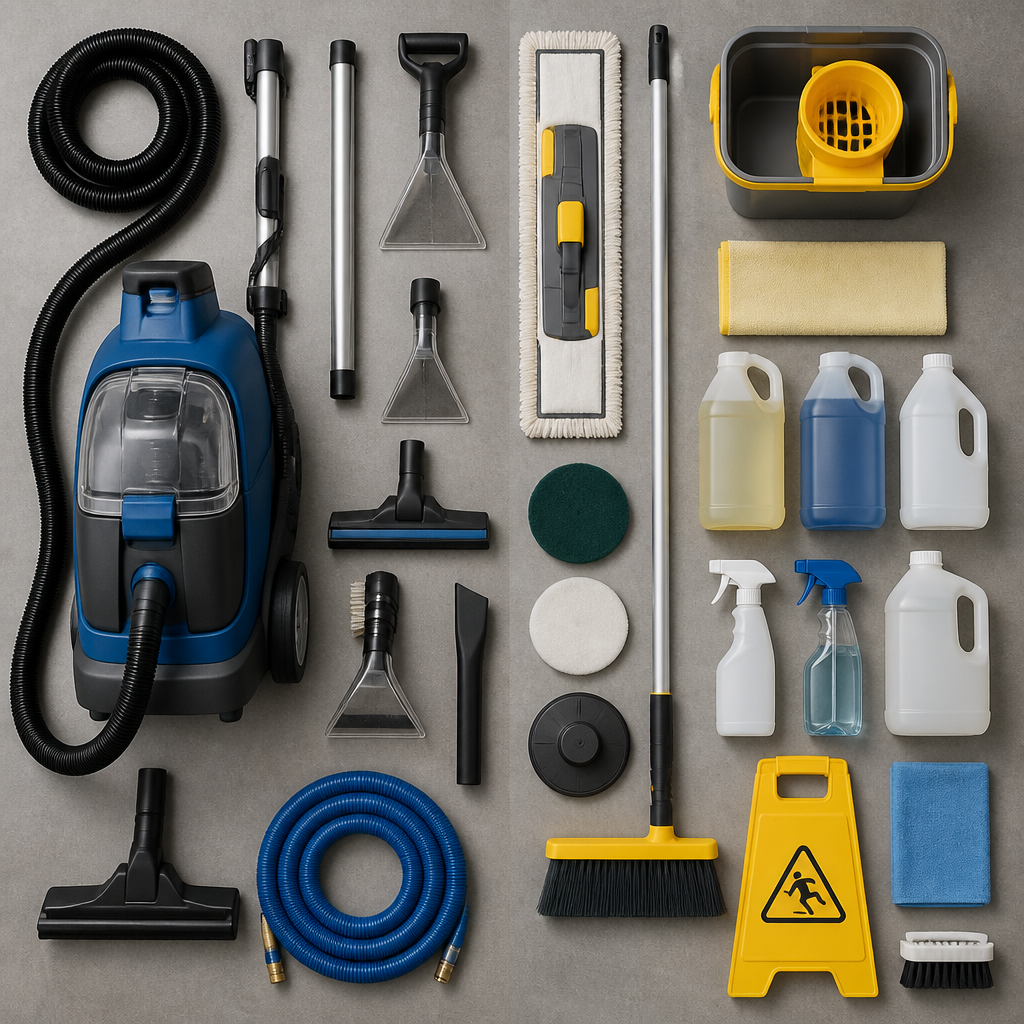
The table below compares the two surface categories across the maintenance dimensions that matter most to Auckland commercial property managers. The goal is not to determine which surface is better in general, but to make the maintenance requirements of each explicit so that budget and scheduling decisions are informed rather than guesswork.
| Maintenance Factor | Commercial Carpet | Hard Floor (Vinyl / Sealed Concrete / Tile) |
|---|---|---|
| Daily maintenance | Vacuuming; spot treatment for spills | Sweeping or dust mopping; damp mopping as required |
| Deep clean method | Hot water extraction (preferred) or dry encapsulation | Auto-scrubbing; high-pressure scrubbing for grout lines |
| Periodic restorative treatment | Hot water extraction every 3 to 6 months (general office) | Strip and seal once or twice a year for moderate-traffic vinyl |
| Drying / downtime required | 4 to 12 hours for hot water extraction; 30 to 60 mins for encapsulation | Several hours after strip and seal; minimal after mopping |
| Air quality impact | Traps allergens and particulates; deep cleaning restores filter function | Does not trap particulates; contaminants remain on surface until cleaned |
| Slip risk management | Low risk on dry carpet; wet carpet is dangerous | Higher risk in wet areas; anti-slip treatment may be required |
| Visible vs hidden soil | Surface can look clean while pile is contaminated | Surface soiling is visible; coating wear is not until advanced |
| Replacement lifespan (NZ) | 8 to 15 years depending on quality and maintenance | Hard floors generally outlast carpet when properly maintained |
Office Floor Cleaning Zones: Matching the Method to the Traffic
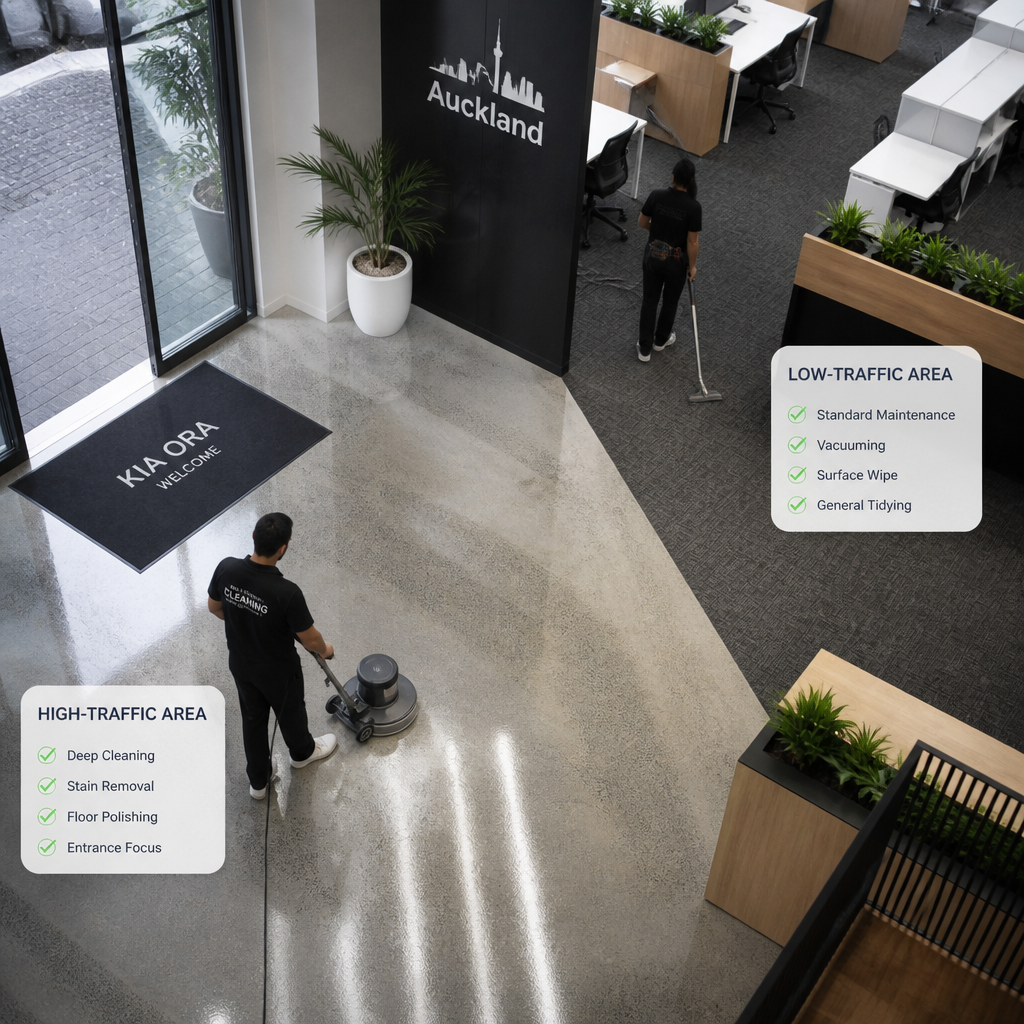
The most practical way to manage office floor cleaning in an Auckland commercial building is to map the building into traffic zones first, then assign appropriate cleaning methods and frequencies to each zone. This is more efficient than applying a single standard across the whole site and produces better results per dollar spent.
Zone 1: Entry, reception, and lobby areas
These are the highest-traffic areas in any commercial building. They face daily ingress of outdoor contaminants, including rain, dust, and tracked-in soil, which is relevant for Auckland given the volume of wet-weather days the city experiences. Carpet in these zones should be on a monthly professional cleaning schedule at minimum. Hard floors in these zones need regular damp mopping, frequent buffing, and a strip and seal cycle at least annually. Entry mats and barrier matting help reduce the rate at which contaminants reach the main floor surface, but they are a supplement to the cleaning schedule, not a substitute for it.
Zone 2: Open-plan work areas and corridors
These are moderate-to-high traffic zones depending on headcount and building layout. Carpet in open-plan offices should be deep cleaned every three to six months. Corridors connecting high-traffic areas often sit at the higher end of that range. Hard floor corridors in commercial buildings are often overlooked for buffing and polishing because they are seen as purely functional spaces. This is a mistake. A corridor with a dull, patchy floor finish reflects on the presentation of the entire building.
Zone 3: Private offices, meeting rooms, and low-traffic areas
Carpet in private offices and low-traffic meeting rooms can extend to a six to twelve month deep clean cycle without visible or hygienic degradation. Hard floors in these zones need basic maintenance but can go longer between restorative treatments. The key is not to let budget savings in these zones come at the expense of reducing frequency in Zones 1 and 2, where the impact of under-maintenance is immediate and visible to clients and visitors.
A floor maintenance plan that ignores traffic zones is not a plan. It is a schedule that will cost more to fix than it saves to run.
Common Mistakes Auckland Properties Make with Floor Maintenance
After working across commercial properties in Auckland, certain patterns of avoidable floor damage come up repeatedly. These are not unusual situations. They are the standard outcome when floor maintenance is managed reactively rather than proactively.
Deferring strip and seal until the floor has failed
This is the most expensive mistake in hard floor maintenance. Property managers sometimes defer the strip and seal because they want to avoid the cost and the temporary closure of the area. The result is a floor that has lost its protective coating, has begun trapping soil at the substrate level, and now requires significantly more labour and product to restore. In practice, timely maintenance is almost always less expensive per year than deferred restoration.
Using the wrong cleaning product on a sealed floor
Harsh or incorrect cleaning chemicals strip sealer coatings prematurely. In a building where the cleaning team uses a multi-purpose floor cleaner that is too alkaline for the sealer type, the coating degrades in months rather than years. This is a specification problem, not a frequency problem, and it requires the cleaning provider to match chemical selection to the specific floor type and coating in use.
Under-vacuuming before carpet deep cleaning
A common mistake is to deep clean carpet that has not been thoroughly vacuumed first. Dry soil left in the pile during hot water extraction turns to mud and is harder to extract, which increases drying time and reduces the quality of the clean. Every professional carpet cleaning service should begin with thorough vacuuming of the area, including along edges and under furniture where possible.
Treating the whole building as one zone for scheduling
This produces a schedule that is either too frequent for low-traffic areas, wasting budget, or too infrequent for high-traffic areas, causing damage. A building of any meaningful size in Auckland has at least three distinct traffic zones that should each have their own cleaning frequency assigned by surface type.
Frequently Asked Questions
How often should commercial carpets be professionally cleaned in Auckland?
The frequency depends on the traffic zone. General office areas benefit from professional cleaning every three to six months. High-traffic areas such as reception, lobbies, and retail floors should be cleaned monthly or every one to three months. Medical centres require monthly cleaning as a baseline. Low-traffic private offices can extend to every six to twelve months. If you cannot zone your building, use a three-month cycle for all areas as a safe default that covers most commercial situations.
What is the difference between hot water extraction and steam cleaning?
The terms are used interchangeably in commercial cleaning, but they describe the same process. Hot water, not steam, is injected under pressure into the carpet pile along with a cleaning solution and immediately extracted by high-powered suction. This method removes embedded soil, allergens, and biological material far more effectively than surface cleaning. It is the method recommended by most carpet manufacturers for periodic deep cleaning of commercial carpet.
How often does a commercial vinyl floor need to be stripped and resealed in New Zealand?
For most commercial vinyl floors in moderate-traffic environments, stripping and resealing once or twice a year is the recommended baseline. High-traffic areas including school corridors, retail floors, and building entry zones may need this service more frequently. Deferring the strip and seal cycle beyond these intervals typically results in a more expensive and labour-intensive restoration process than scheduled maintenance would have required.
Is carpet or hard floor better for commercial offices in Auckland?
Both serve different functions and are rarely in direct competition within a single building. Carpet is better for acoustic comfort, thermal warmth, and air filtration in open-plan work areas. Hard floors are better suited to high-spill areas such as kitchens, bathrooms, and building entries where hygiene control and moisture resistance are priorities. Most Auckland commercial buildings use both for good reason. The key is maintaining each surface correctly rather than choosing one over the other.
Can I extend the time between professional carpet cleans if I vacuum regularly?
Regular vacuuming is essential and significantly slows the rate of soil accumulation in carpet fibres. However, vacuuming alone cannot remove the embedded soil, allergens, and biological matter that builds up in the carpet pile over time. Professional deep cleaning addresses contamination that vacuuming cannot reach. Extending the interval beyond the recommended schedule for your traffic zone will result in permanently embedded soil that reduces carpet lifespan and affects indoor air quality, regardless of how thorough the interim vacuuming is.
What should I look for in a commercial floor cleaning provider in Auckland?
Look for a provider that carries public liability insurance, uses appropriate methods and chemicals for each floor type, offers flexible scheduling that works around your business hours, and can develop a maintenance plan that separates your building into traffic zones. A provider that applies the same schedule and method to every surface in your building without first assessing traffic patterns and surface types is not delivering a genuine maintenance service. Also confirm whether they handle both carpet and hard floor maintenance, since managing both through a single provider simplifies coordination and reduces the risk of scheduling gaps.
Does Triple Star Commercial Cleaning service both carpet and hard floors in Auckland?
Yes. Triple Star Commercial Cleaning provides commercial carpet cleaning, hard floor maintenance including strip and seal, floor polishing, and regular office cleaning across Auckland. All sites are covered by public liability insurance and the team works with property managers, business owners, facility managers, and body corporates to develop maintenance plans suited to each building’s specific surfaces and traffic patterns. The Auckland office can be reached on 0800 90 1225.
If you manage a commercial property in Auckland with mixed carpet and hard floor surfaces, we would like to hear how your current cleaning schedule is working for you. Drop a comment or get in touch directly to share what has and has not worked in your building.
We would love your feedback and any insights you would share with others. What perspective would you add?
References
- Recommended commercial carpet cleaning frequency guidelines for New Zealand offices and commercial spaces
- New Zealand flooring cost and maintenance comparison for carpet and hard floor surfaces
- Commercial carpet and flooring options for New Zealand investment properties and retail spaces
- Hard floor cleaning and strip and seal frequency guidance for New Zealand commercial environments
- Hard floor maintenance and polishing services for Auckland commercial properties