A childcare centre can pass a quick walk-through and still fail the cleaning standards that matter most. The gaps usually sit in the places nobody scheduled: the nappy change mat after the third change of the morning, the blocks that toddlers mouth, or the craft table wiped once at close of day. For centres in Christchurch and Auckland, the Ministry of Education’s licensing expectations set a clear floor for childcare centre cleaning in NZ that has to be met every day, not just during inspections. This guide explains what those expectations mean in practice, how to build a routine that holds up, and what to look for when you bring in a professional cleaning partner.
Table of Contents
- Quick Takeaways
- What the Ministry of Education Expects From Your Cleaning
- Daily Cleaning Routines That Hold Up Under Inspection
- Nappy Change Areas: The Non-Negotiable Routine
- Cleaning, Sanitising and Disinfecting Are Not the Same Job
- Soft Surfaces, Rugs and Carpets
- In-House Staff, Contract Cleaning or a Hybrid Model
- Documenting Your Cleaning Plan So It Can Be Checked
- Choosing a Professional Cleaning Partner for Your Centre
- Frequently Asked Questions
- References
Quick Takeaways
| Key Insight | Explanation |
|---|---|
| Nappy change areas need cleaning after every change | The licensing criteria expect cleaning and disinfection after each nappy change, so build the task into the change routine and a sign-off sheet beside the mat. |
| Toys and hard surfaces get washed daily | Hot soapy water each day is the baseline. Put blocks, sensory bins and storage tub lids on the room checklist so no item is missed. |
| Check the disinfectant label, not the brand | The criteria call for a product effective against protozoa, bacteria and viruses. Confirm that claim on the label and keep the product information on file. |
| Clean first, then sanitise or disinfect | Dirt and food residue block chemicals from working. A disinfectant sprayed on a sticky table does a poorer job than the same product on a wiped surface. |
| Soft textiles need washing and full drying | Launder washable items on the warmest suitable setting, dry them completely, and keep soiled and clean laundry in separate labelled baskets. |
| Written records are what inspectors check | A one-page schedule per room and daily initialled sign-offs prove that cleaning happened. Without them, a clean centre can still look like it has no system. |
What the Ministry of Education Expects From Your Cleaning
Licensed early childhood services in New Zealand operate under the Education (Early Childhood Services) Regulations 2008 and the Licensing Criteria for Early Childhood Education and Care Services 2008. Cleaning is not a single clause you tick off. It runs through the health and hygiene expectations that shape how a centre handles toys, nappy changing, food areas and shared surfaces every day.
In practice, the most common gap we see is not a missing product or a dirty floor. It is a cleaning plan that assumes the after-hours cleaner will catch everything. Expectations apply to what happens during opening hours, when toddlers are mouthing blocks and tables are covered in paint and lunch. A plan that only works when the contractor is on site is not really a plan.
A cleaning schedule proves its worth on a Tuesday afternoon, when the room is full and the wipe-down still happens.
Daily duties that cannot wait for the night shift
The criteria require toys and hard surfaces to be cleaned daily with hot soapy water. They also require nappy changing areas to be cleaned and disinfected after every nappy change. Those two duties alone rule out a plan built around a single end-of-day clean.
The criteria also call for a disinfectant that is effective against protozoa, bacteria and viruses. That matters because a general-purpose spray that works well on a kitchen bench may not carry that claim. Read the label, confirm the active ingredient and keep the product information on file.
Centres in Christchurch and Auckland often ask whether the Ministry names a specific product. The criteria describe what the disinfectant must be able to do rather than which brand to buy, so the choice comes down to the label and the records behind it.
Daily Cleaning Routines That Hold Up Under Inspection
A workable daily routine splits the work into three windows: before opening, during the day, and at close. Trying to do everything at close leaves the middle of the day exposed. Splitting it lets staff handle spills and high-contact points while the room is in use.
Toys and hard surfaces
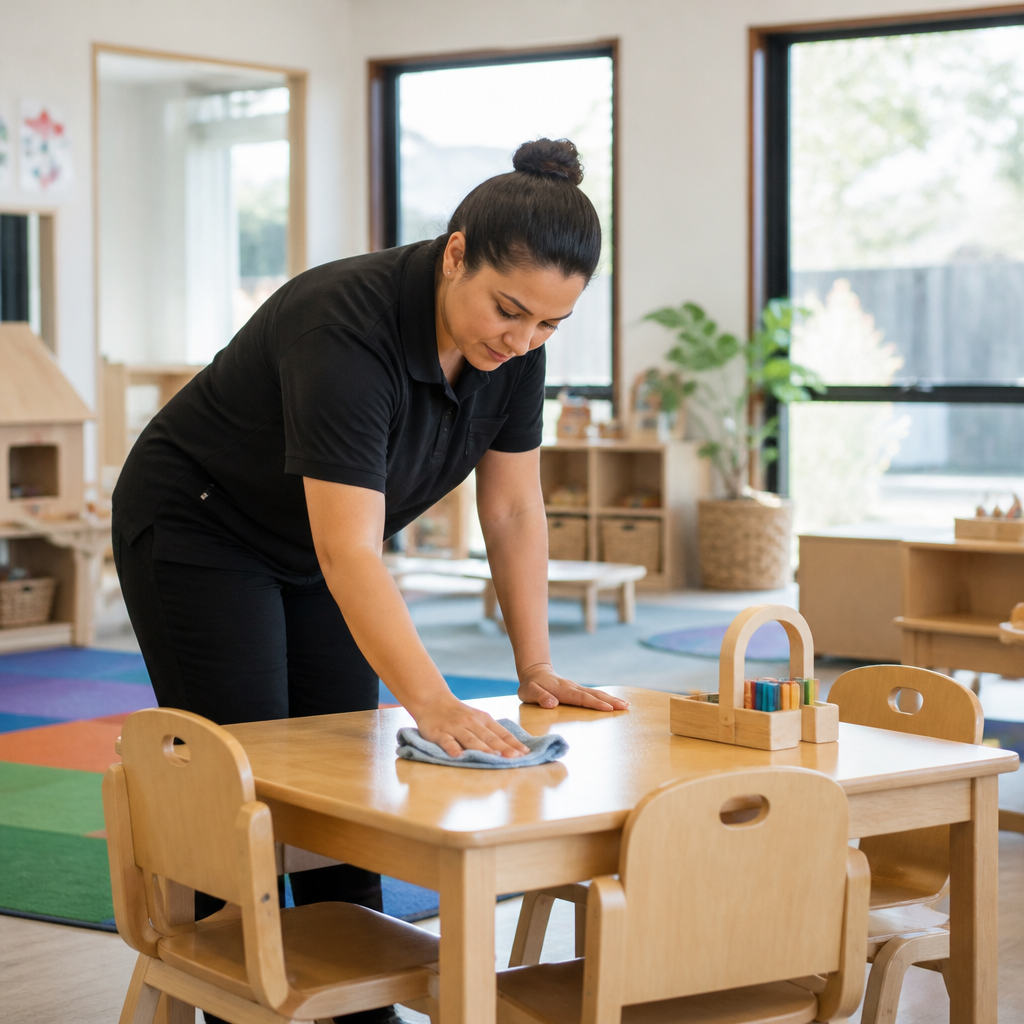
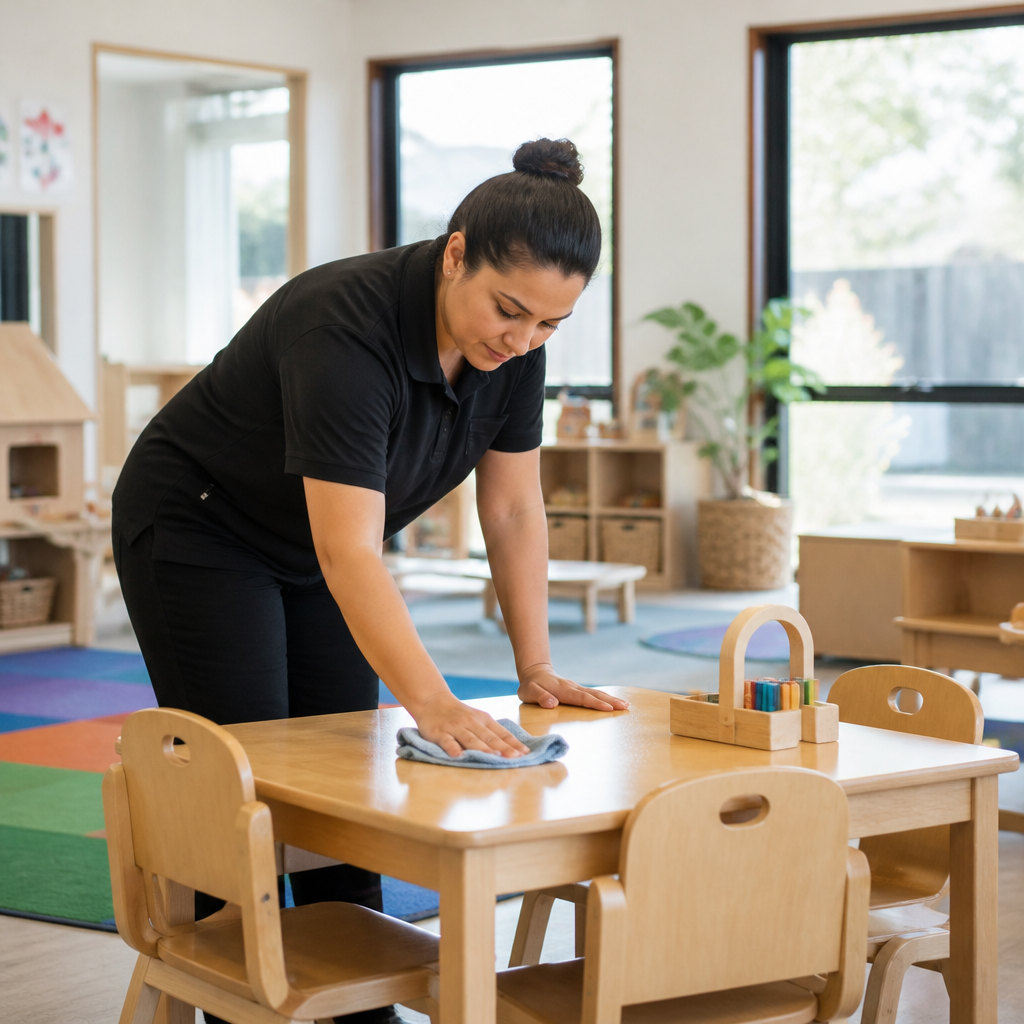
Toys and hard surfaces need washing with hot soapy water each day. Blocks, plastic kitchen sets, sensory bins and the lids of storage tubs all belong on the list. Mark them on the room checklist so nobody assumes someone else washed the tricycles.
Dry items fully before they go back on the shelf. Damp plastic and wood hold moisture that does nothing for hygiene. A drying rack in the store room saves more time than most staff expect.
Meal tables, craft areas and high-touch points
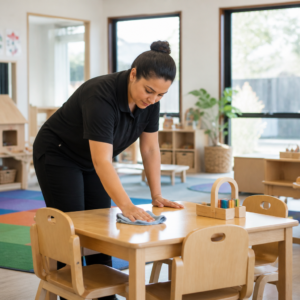
Clean visibly dirty surfaces, including lunch tables and craft areas, after each meal or activity. The CDC guidance on early care settings takes the same approach, noting that high-touch surfaces such as tabletops, handles and toys are the most likely to carry germs. Tables that serve both craft and lunch carry the most traffic, so they should be cleaned between uses rather than once at close.
Door handles, light switches, taps and cupboard pulls are easy to forget because they look clean. Add them to a fixed run in the afternoon, when the room is busiest and the handles are handled most.
Pro tip: Put a wipe-down slot on the afternoon run sheet, right after snack time. Staff are far more likely to clean a table when the task is tied to something that already happens.
Nappy Change Areas: The Non-Negotiable Routine
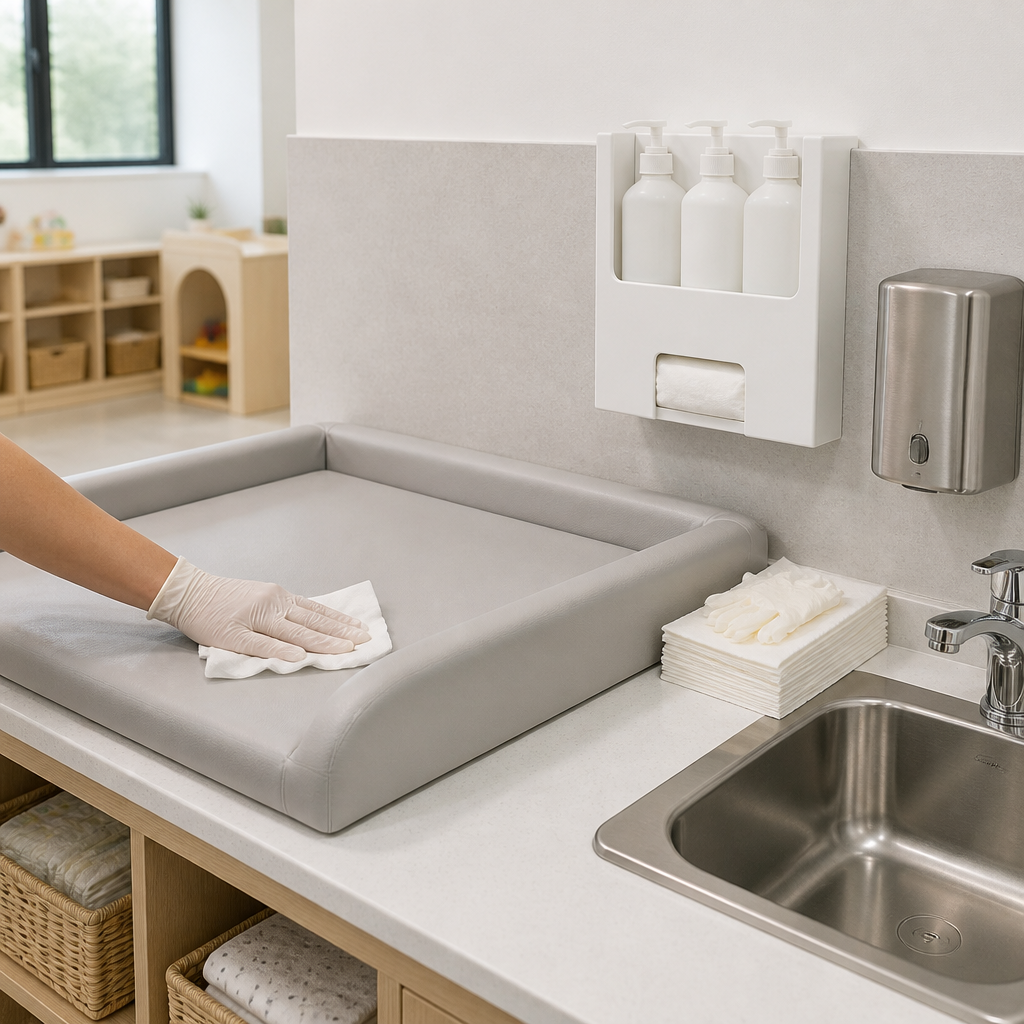
Nappy change areas are where most centres either pass or fail cleaning checks, because the task repeats dozens of times a day. The licensing criteria require cleaning and disinfection after every nappy change, which means the routine has to be designed for speed and repetition, not thoroughness at the end of the day.
Setting up the change station for speed
Keep the disinfectant, paper towels, gloves and a lined bin within arm’s reach of the change mat. When staff have to walk to a cupboard for supplies, the step that gets skipped is usually the disinfection. A fully stocked station makes the correct sequence the easy one.
Place a sign-off sheet beside the station with a column for each time block. It does not need to be elaborate. A tick and initials give you evidence that the task happened, which is exactly what an inspector will ask for.
Common mistakes we see in centres
The most common mistake is wiping the mat once in the morning and assuming the rest of the day is covered. The second is using one cloth for the mat, then the basin, then the toy shelf, which moves germs around instead of removing them. Use a fresh cloth or wipe for each surface zone, and bin it after use.
Another frequent issue is mats that are stored damp. Let the surface dry fully after disinfecting, and check the mat for cracks each week. Torn vinyl gives germs a hiding place that a standard wipe will not reach.
Cleaning, Sanitising and Disinfecting Are Not the Same Job
The three words get used interchangeably in centre policies, and that causes problems at audit time. Cleaning uses soap, water and scrubbing to remove germs, dirt and impurities from surfaces. On its own, cleaning removes most types of harmful germs, including viruses, bacteria, parasites and fungi.
Sanitising reduces the number of germs on a surface to levels that public health codes or regulations consider safe. Disinfecting uses stronger chemical products to destroy any remaining germs after cleaning. Each step has a different job, and treating them as one step is how surfaces end up looking clean without being safe.
Why cleaning always comes first
Clean surfaces before you sanitise or disinfect them, every time. Dirt and organic matter sit between the chemical and the germ, which makes the product less effective. A disinfectant sprayed onto a sticky table will underperform the same product used on a wiped surface.
In busy rooms, a two-cloth method works well. One cloth and detergent removes the mess, and a second pass with the disinfectant treats the cleaned surface, following the label’s contact time. Label the bottles clearly so staff can tell them apart at a glance.
When disinfection is required
Disinfect when someone in the room is sick or at higher risk of getting sick. Sanitise surfaces that touch children’s mouths, such as infant feeding items and shared toys, as a routine step. Build a short list of these items into the room plan so the decision is not left to memory on a busy morning.
Soft Surfaces, Rugs and Carpets
Soft surfaces are the hardest part of a childcare cleaning plan because they cannot be sanitised the same way as a table. They hold moisture, dust and whatever has been dropped on them, and they are used for floor play, sleeping and story time. A plan that ignores them is incomplete, however good the hard-surface routine looks.
Washable textiles and cloth toys
Launder washable items according to the manufacturer’s instructions, using the warmest appropriate water setting, and dry them completely. That covers cot sheets, dress-up clothing, cushion covers and cloth toys. If an item cannot be washed, clean it with a product suitable for that material and check the label before using anything strong.
Keep a labelled basket for soiled textiles and a separate one for clean stock. Mixing the two is a common way for contamination to spread, and it makes the audit trail harder to follow.
Vacuuming and professional carpet cleaning
Vacuum rugs and carpeted floor areas regularly, and remove visible dirt before any wet treatment. Carpets that look dry can still hold food, sand and small objects that children pick up. A vacuum with a good filter matters more than people expect, because a cheap machine can blow fine dust straight back into the room.
Professional carpet cleaning sits between daily vacuuming and a full wash. We recommend scheduling it on a fixed cycle, and sooner after a spill that was not fully removed. Book it for a time when the room can stay closed to children until the surface is completely dry.
In-House Staff, Contract Cleaning or a Hybrid Model
Most centres do not choose between a perfect plan and an imperfect one. They choose how the work is split between teaching staff, a dedicated cleaner and an outside contractor. Each model has a predictable failure point, and knowing it in advance makes the schedule easier to defend.
The table below compares the three approaches we see most often in practice.
| Approach | Where It Works | Where It Breaks Down |
|---|---|---|
| In-house staff only | Low cost, and good for quick wipe-downs and daytime spills. | Teaching staff run out of time, and deep cleaning and product records slip. |
| Contract cleaning after hours | Deep cleans, floors, carpets and scheduled disinfection run without disrupting children. | Daytime spills wait until the next morning, and the centre relies on the contractor’s sign-off alone. |
| Hybrid model | Staff handle daytime wipe-downs and nappy areas, while the contractor covers deep cleaning, floors and periodic disinfection. | It needs a shared checklist and a clear owner for each task, or both sides assume the other has done it. |
In our experience, the hybrid model works best when one named person signs off the daily checklist, whether that is the centre manager or a senior educator. Without that person, the split of duties turns into a gap nobody owns.
The handover between groups is where most things go wrong. A contractor arriving in the evening needs to know which rooms had incidents during the day, which products are in use and which surfaces need extra attention. A one-page handover sheet solves most of that.
Documenting Your Cleaning Plan So It Can Be Checked
Inspectors and auditors cannot see what was never written down. The cleaning plan shows the centre has thought about hygiene, and the sign-off sheets show that it happened. Without both, even a spotless centre can look like it has no system at all.
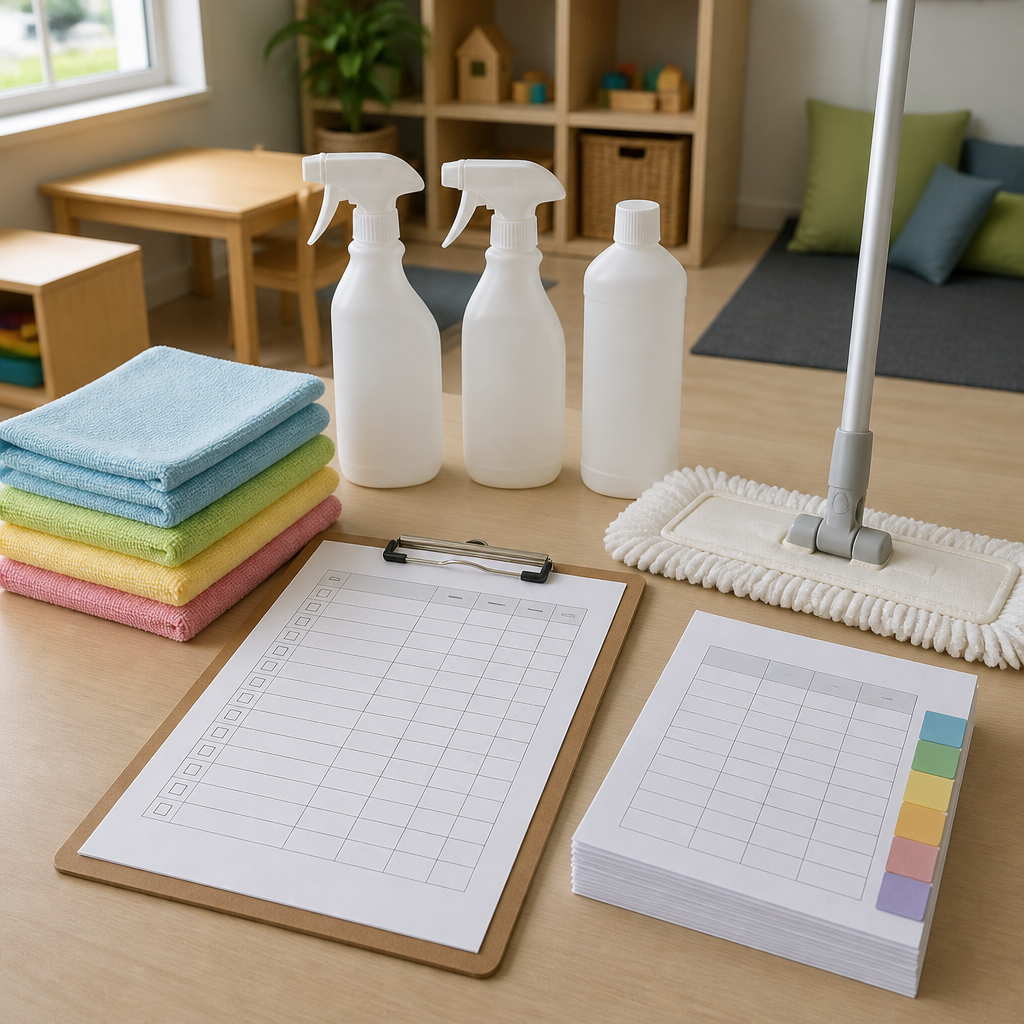
What a usable cleaning schedule looks like
A good schedule lists each task, the room or area, the frequency, the product used and the person responsible. It should fit on one page per room. If it runs to twenty pages, staff will not read it, and the document becomes decoration rather than a tool.
Review the schedule each term, or whenever the room layout changes. A new climbing frame or a relocated sink changes the high-touch surfaces, and the plan needs to reflect that.
Sign-off records and product information
Keep daily sign-off sheets for nappy change areas and for the washing of toys. Store product safety data sheets and label copies in a binder near the store room, and make sure every staff member knows where it is. When a product changes, update the schedule the same day.
A common mistake is keeping records only on a manager’s phone or in a head office system that nobody on site can open. Keep a printed copy on the wall of the room that matters most, and a digital backup.
Choosing a Professional Cleaning Partner for Your Centre
A professional cleaning partner can take the after-hours deep clean, the floors, the carpets and the scheduled disinfection, leaving teaching staff free for the daytime tasks only they can do. The right partner understands that a childcare centre is not an office, and that cleaning around children’s routines is a skill in its own right.
Questions to ask before you sign
Ask how the team handles nappy change areas and whether they hold themselves to the same daily standard as your own staff. Ask which disinfectant they use, whether they can supply the product information and how they confirm a task was completed. A vague answer to any of these is worth following up.
Ask how they work around sleep times, drop-off, pick-up and emergency closures. A crew that arrives during nap time with vacuums running is a crew you will regret. We build our schedules around the centre’s day, not the other way round.
Insurance, approvals and access
Check that the company carries public liability insurance and that its cleaners are trained to work around children. Triple Star Commercial Cleaning is an UpstreamNZ approved supplier, and all of our cleaning sites are covered by public liability insurance. Ask for copies before the first visit, not after an incident.
Pro tip: Agree on a key and access process in writing before the first visit. Note who holds keys, how alarms are handled and which rooms are off limits during sleep time. Most access problems come from assumptions, not bad intent.
Run a two-week trial with a checklist and a walk-through at the end of the first week. If the nappy change sign-offs are complete and the rooms look right at handover, you have a partner worth keeping. You can learn more about how we work at our website.
Frequently Asked Questions
How often do toys in a childcare centre need to be cleaned?
The licensing criteria require toys and hard surfaces to be cleaned daily with hot soapy water. Toys that children mouth, or that move between rooms, should be checked more often and sanitised where needed.
Does a childcare centre need a specific disinfectant?
The criteria require a disinfectant that is effective against protozoa, bacteria and viruses. Check the product label for that claim, follow the dilution and contact time on it, and keep the safety data sheet on file.
Can a cleaning contractor work while children are in the centre?
Some tasks can happen during opening hours, such as spot cleaning and washroom checks. Deep cleaning, floor work and chemical use are best done after children leave, so agree on the schedule in advance.
Do carpets in a childcare centre need professional cleaning?
Yes, on a regular schedule. Daily vacuuming handles surface dirt, but professional carpet cleaning removes what builds up beneath it. Book it for a time when the room can stay closed until the surface is fully dry.
What should a centre do if an inspection finds a cleaning gap?
Treat it as a process problem rather than a one-off. Find out whether the task was missing from the schedule, whether the person responsible was unclear or whether the records were incomplete. Then fix that root cause and document the change.
We would like to hear from centre managers about which cleaning task is hardest to keep on schedule in your centre, so please share your experience with us.