Most offices do not suddenly become dirty overnight. The decline is gradual, and that is exactly what makes it easy to ignore. A dusty vent here, a sticky kitchen bench there, carpets that have gone from grey-beige to grey. If your office cleaning Christchurch or Auckland schedule has not kept pace with how your business has grown, there is a good chance the warning signs are already present. You just need to know what to look for. This article walks through the seven clearest signals that your current approach is not working, and what a professional commercial cleaning team can realistically do about each one.
Table of Contents
- Quick Takeaways
- Sign 1: Persistent Odours That Do Not Go Away
- Sign 2: Rising Employee Sick Days
- Sign 3: Visible Dust on Surfaces and Vents
- Sign 4: Carpets and Upholstery Look Worn or Stained
- Sign 5: Clients and Visitors Are Noticing
- Sign 6: Your In-House Cleaning Is Inconsistent
- Sign 7: Staff Are Complaining or Silently Disengaging
- Cleaning Approach Comparison
- Frequently Asked Questions
- References
Quick Takeaways
| Key Insight | Explanation |
|---|---|
| Odours signal hidden dirt, not just surface mess | Bad smells in shared spaces usually trace back to damp carpets, neglected bins, or poorly maintained air conditioning systems, not just yesterday’s lunch. |
| Sick day spikes are often a cleaning problem | High-touch surfaces like door handles, shared keyboards, and kitchen taps spread pathogens rapidly when not disinfected regularly. Professional cleaning targets these directly. |
| Dust on vents is never cosmetic | Blocked or dusty vents recirculate allergens and reduce air quality throughout the entire office, affecting focus and respiratory health. |
| Carpet condition affects asset value | Commercial carpets that are not deep-cleaned periodically degrade faster, costing more to replace. This matters especially to property managers and building owners. |
| Client impressions form in seconds | A dirty reception area or stained meeting room tells visitors exactly how much care goes into the business. It is difficult to recover from that impression mid-meeting. |
| Inconsistent cleaning is worse than infrequent cleaning | Staff tolerate a lot, but unpredictable standards create resentment. A documented cleaning schedule with sign-off records changes the dynamic entirely. |
| Staff silence is not satisfaction | Nobody directly tells a business owner their office is dirty. They disengage instead. Complaints, when they do surface, usually mean the problem has been building for weeks. |
Sign 1: Persistent Odours That Do Not Go Away
If you walk into your office on a Monday morning and catch a stale or musty smell, that is not normal and it is not something a scented diffuser will fix. Persistent odours in shared spaces, break rooms, or bathrooms are one of the earliest indicators that dirt has accumulated somewhere that routine surface wiping is not reaching.
The most common culprits are damp or soiled commercial carpet, overflowing bins that were not emptied on schedule, and air conditioning units whose filters have not been maintained. In Christchurch and Auckland offices, where older commercial buildings can have ventilation systems that were not designed for modern open-plan layouts, stale air is a particularly common complaint.
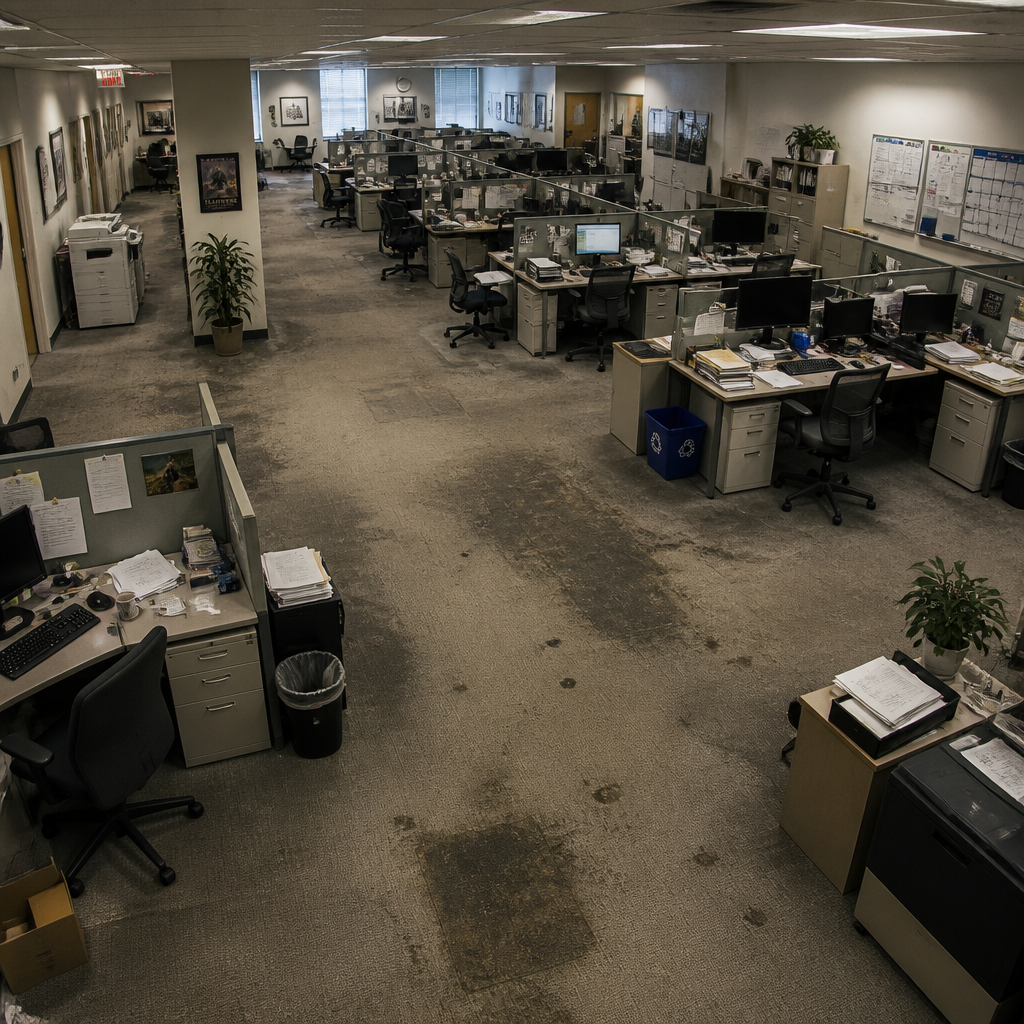
What a professional cleaning team does differently is treat the source rather than the symptom. That means hot water extraction on carpets where odour-causing bacteria have embedded into the fibres, thorough cleaning of bin liners and bin surrounds, and flagging ventilation issues to the facilities team for follow-up. Masking an odour is not cleaning. Removing what is causing it is.
Pro tip: If the smell is worst near the kitchen or bathroom, ask your cleaning provider to add a bacteria-treatment step to the drain and sink surrounds. These areas harbour odour-causing microbes that standard surface sprays miss entirely.
Sign 2: Rising Employee Sick Days
A noticeable increase in sick leave among your team is rarely a coincidence. Offices are high-density shared environments, and surfaces that are touched repeatedly throughout the day, including door handles, shared keyboards, lift buttons, kitchen appliances, and meeting room remotes, become vectors for spreading illness when they are not disinfected properly.
The New Zealand context is specific here
Research cited by Southern Cross Health Society found that the average New Zealand employee took 5.5 sick days in 2022, amounting to nearly 10 million lost working days nationwide. When you factor in lost productivity, cover costs, and the workload pressure on the staff who remain, a spike in sick leave is a measurable business cost, not just an inconvenience.
High-touch surfaces need targeted disinfection on a scheduled basis, not a wipe-down when someone remembers to do it. A professional office cleaning service will include a disinfection protocol as a standard line item, specifying which surfaces are treated, with what product, and at what frequency. That level of documentation matters, particularly for medical centres, schools, and retail environments where Triple Star operates.
Pro tip: Ask any cleaning provider you are evaluating to show you their disinfection schedule in writing. If they cannot produce one, their high-touch surface cleaning is probably ad hoc, and ad hoc is not good enough for a shared workspace.
Sign 3: Visible Dust on Surfaces and Vents
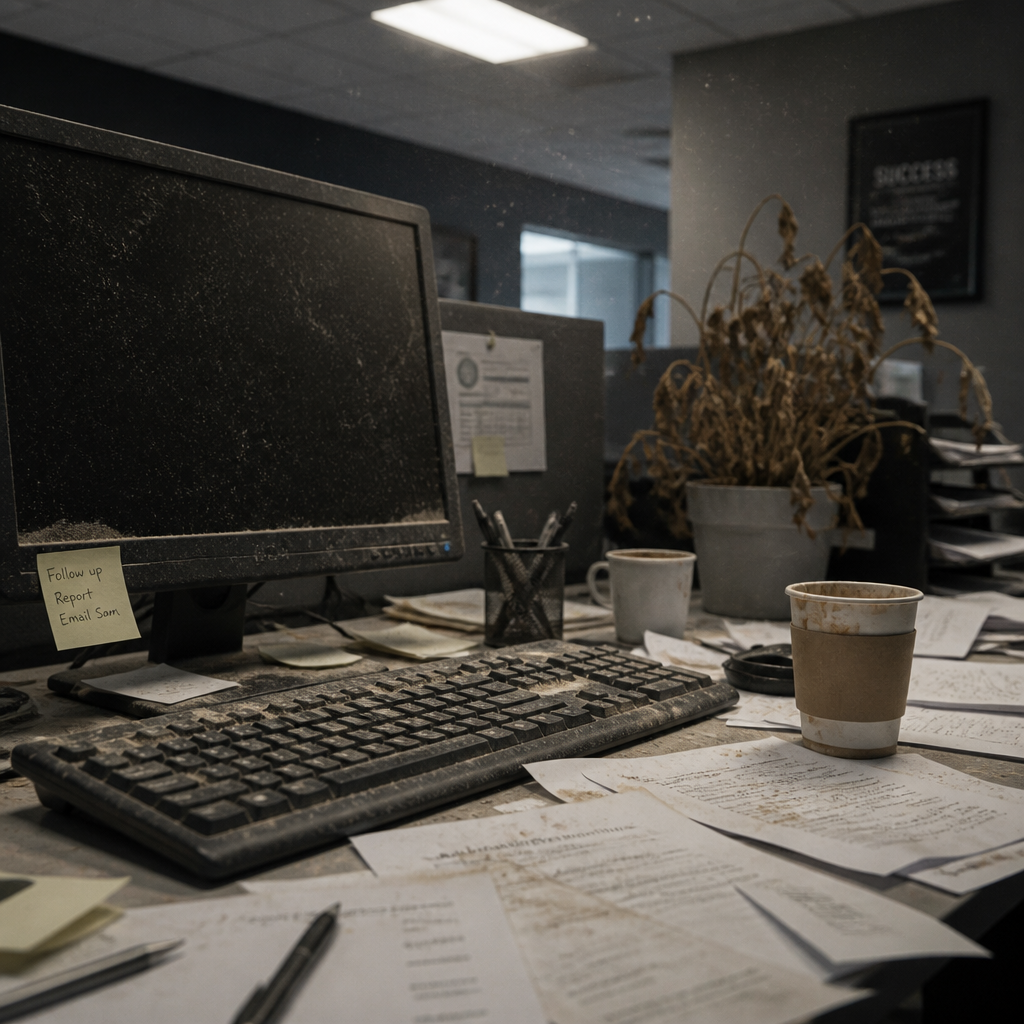
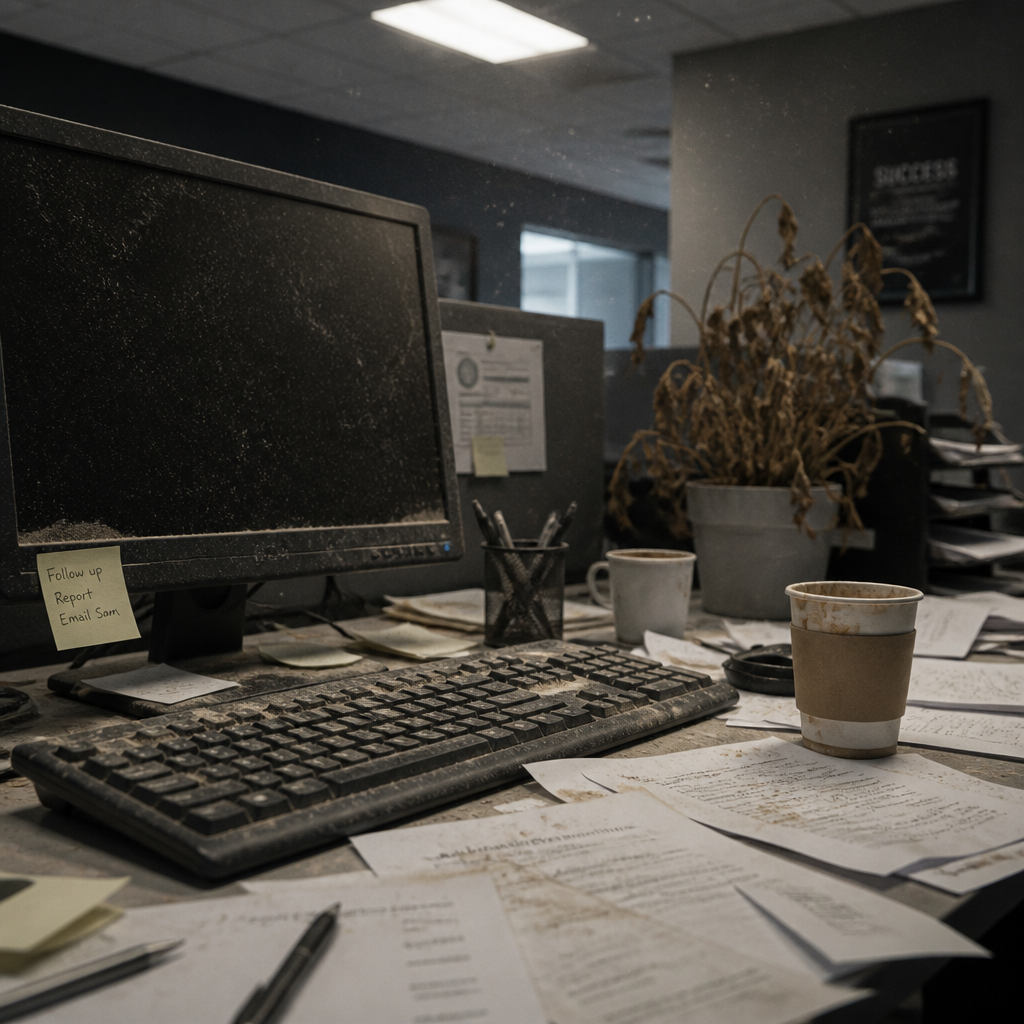
Dust on shelving or window ledges is an obvious sign. Dust on air vents and diffusers is the more serious one that most offices overlook. When ventilation outlets are coated in grey particulate, the system is actively circulating those particles through the air that your staff breathe throughout the day.
What dust is actually doing to your team
Research published on ResearchGate confirmed a correlation between higher particle counts in office air and lower perceived productivity among employees. Dust does not just look bad. It actively affects how well people think and how they feel in the space. For staff already dealing with allergies or respiratory sensitivities, a dusty office is not just uncomfortable; it is a health risk.
Surface-level dusting of desks is not the same as proper dust management. A professional cleaning team will address ceiling vents, overhead light fittings, the tops of shelving units, and the sides and backs of equipment that weekly office cleans routinely skip. This is especially relevant in open-plan offices with exposed ductwork, which are common in converted commercial buildings across Christchurch’s central city and Auckland’s CBD fringe.
Employees evaluate their own productivity lower when more dirt and stains are found on office surfaces and when particle counts in the ambient air are higher. A clean office is not a luxury standard. It is a performance standard.
Sign 4: Carpets and Upholstery Look Worn or Stained
Commercial carpet is one of the most significant assets in any office. It is also one of the most neglected. Vacuuming removes surface debris, but it does not extract the oils, bacteria, beverage residues, and organic material that have embedded into the carpet fibres over months of daily foot traffic.
When vacuuming is no longer enough
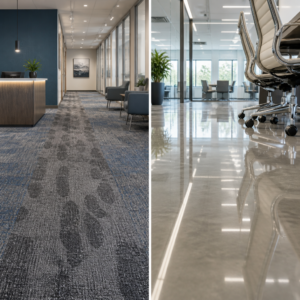
The visual tell is a carpet that no longer looks clean even right after it has been vacuumed. If the high-traffic corridors look noticeably darker or flattened compared to areas under furniture, the carpet needs a professional hot water extraction treatment, not just more frequent vacuuming.
For Christchurch and Auckland offices between tenancies or during a seasonal shutdown, that is the optimal window for carpet deep extraction and upholstery treatment. The drying time required after hot water extraction, typically around four to six hours for commercial carpet, is manageable when the space is not in use. Property managers overseeing commercial buildings should build this into every end-of-lease process. It protects the asset and ensures the space is genuinely market-ready rather than just visually presentable.
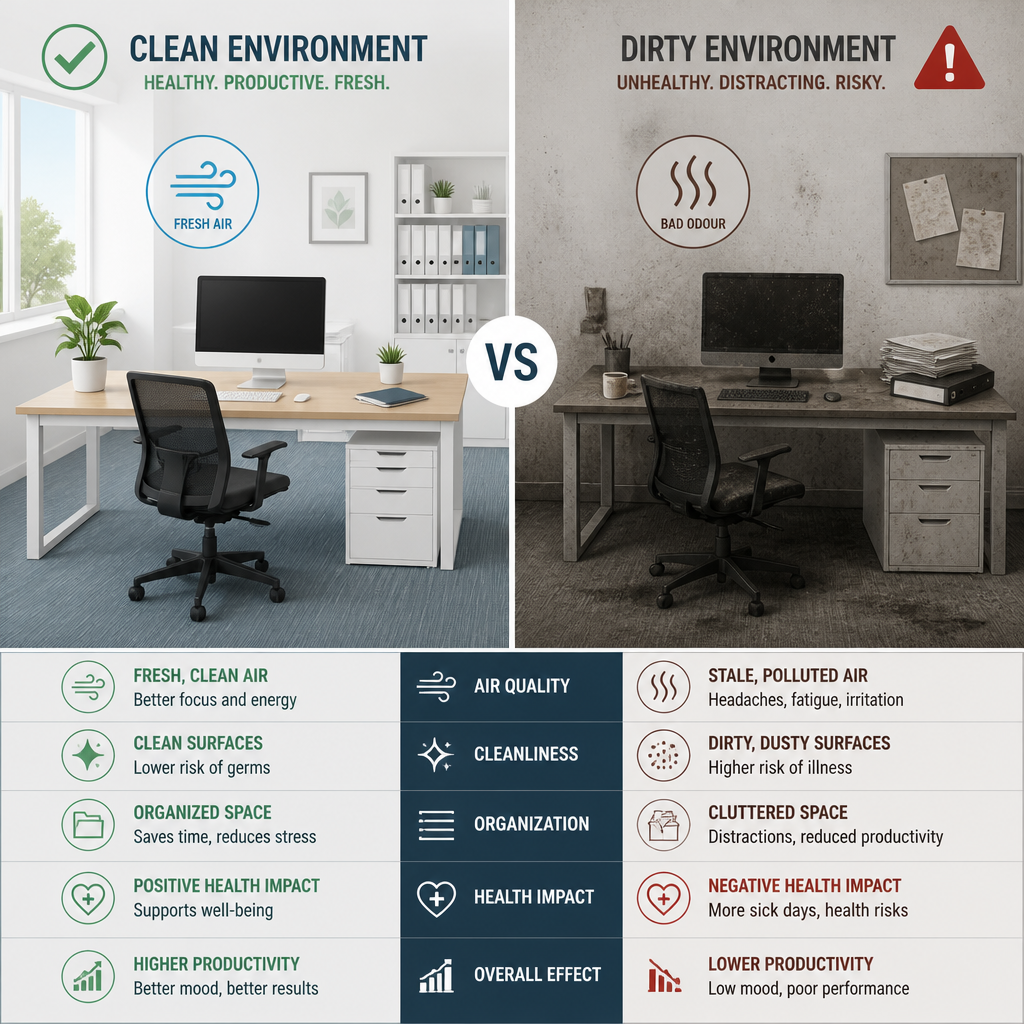
Office chairs and reception sofas collect the same embedded grime. Upholstery cleaning, treated as a periodic service rather than an afterthought, extends the life of furniture that is expensive to replace and signals to staff and clients that standards are actively maintained.
Sign 5: Clients and Visitors Are Noticing
This one is harder to detect precisely because clients rarely say anything directly. What they do is form a judgement and keep it to themselves. A dusty reception desk, scuffed floor tiles in the entry, or a meeting room that smells faintly of yesterday’s coffee tells a visitor something about how the business operates. The impression forms in seconds and is difficult to walk back once the meeting is underway.
Customer-facing spaces require a higher standard
For professional office cleaning in NZ, client-facing areas, including reception, meeting rooms, shared bathrooms, and entry flooring, should be cleaned to a visibly higher standard than back-of-house spaces. This is not about treating staff as less important. It is about understanding where first impressions are made and ensuring those areas are genuinely spotless before client visits.
In Christchurch and Auckland, where businesses regularly host clients, site visits, and contractor meetings, the condition of your office is a form of branding. Property managers showing commercial space to prospective tenants know this well: a clean building lets the space speak for itself, while a dirty one requires constant justification and apology.
Pro tip: Schedule a professional pre-visit clean for any space where you are expecting client walkthroughs. A reactive clean the morning of an inspection is far less effective than a thorough clean the evening before, when there is time to address carpet, glass, and surfaces properly.
Sign 6: Your In-House Cleaning Is Inconsistent
Inconsistency is the most common failure mode for in-house cleaning arrangements. Someone is responsible for cleaning, but the scope is unclear, the supplies are unreliable, and when the person responsible is on leave, nothing gets done. The result is not a uniformly dirty office but a patchwork of clean and neglected areas that creates friction among staff.
What consistent cleaning actually looks like
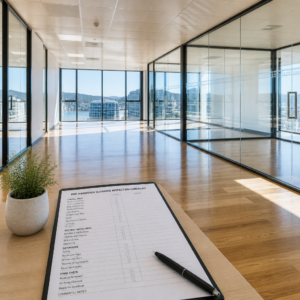
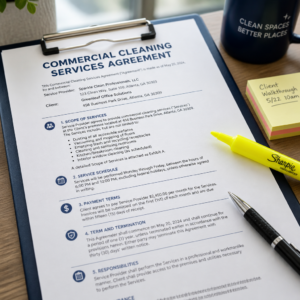
A professional commercial cleaning provider delivers a defined scope of work at an agreed frequency, with documented sign-off. Every visit covers the same list of tasks. If something is missed, there is an accountable process for raising it and getting it corrected. That level of reliability is genuinely difficult to replicate with an informal in-house arrangement, particularly as your business grows.
For office managers in Christchurch and Auckland managing multiple tenants or open-plan workspaces across different floors, a professional cleaning service with a clear scope document is a far more manageable solution than coordinating ad hoc cleaning rosters internally. It removes the cleaning conversation from your weekly task list entirely.
Sign 7: Staff Are Complaining or Silently Disengaging
When employees raise cleanliness complaints directly, it means the problem has already been building for some time. Most staff do not say anything when a bathroom is not stocked or a kitchen bench is sticky. They form a view about whether management cares about their working conditions, and that view affects engagement.
A 2023 survey by Initial Hygiene found that 88 percent of office workers said a clean workplace positively impacted their motivation. For businesses in Christchurch and Auckland competing to retain good staff in a competitive labour market, this is a direct operational consideration. A professional office cleaning schedule is not a perk. It is a baseline working condition that affects how people feel about showing up each day.
When complaints do surface, the instinct is often to ask the cleaner to “do better.” In practice, if the issue is structural, meaning the cleaning scope does not match the size of the space or the frequency does not suit the level of use, telling someone to do better without changing the scope achieves nothing. The right response is a review of the cleaning brief, not a conversation about effort.
Cleaning Approach Comparison
Not all cleaning arrangements deliver the same outcome. The table below compares the three most common approaches business owners and property managers use for workplace hygiene management, based on what consistently works in practice for commercial offices in New Zealand.
| Approach | What It Covers Well | Where It Falls Short |
|---|---|---|
| In-House Staff Cleaning | Quick daily tidying, bin emptying, kitchen wipe-downs | No specialist equipment, inconsistent when staff are absent, no documented scope, no accountability process |
| Franchise Cleaning Networks (e.g., large national chains) | Standardised service across multiple sites, brand recognition | High staff turnover, variable quality between individual franchisees, less responsive to site-specific issues |
| Dedicated Commercial Cleaning Company (e.g., Triple Star) | Consistent named team, documented scope, specialist services (carpet, upholstery, window, builders cleaning), public liability insurance, UpstreamNZ approved supplier | Requires a proper onboarding conversation to set scope. Not suitable if you only want the absolute cheapest option regardless of quality. |
Frequently Asked Questions
How often should a commercial office in Christchurch or Auckland be professionally cleaned?
For most offices with 10 or more staff, a minimum of three times per week is a realistic baseline. High-traffic offices, medical centres, schools, and retail environments typically require daily cleaning to maintain a standard that is actually noticeable. The right frequency depends on foot traffic, the nature of the work carried out, and whether the space is client-facing. A professional cleaning company will assess this during an initial site visit and recommend a frequency that reflects actual usage rather than giving a generic answer.
What is the difference between commercial cleaning and a basic office clean?
A basic office clean covers surface wiping, vacuuming, bin emptying, and bathroom restocking. Commercial cleaning includes all of that plus scheduled deep-cleaning tasks such as carpet extraction, upholstery treatment, window cleaning, floor stripping and sealing, and disinfection of high-touch surfaces using appropriate products. For offices that host clients, operate in regulated industries, or manage significant foot traffic, the deeper scope of commercial cleaning is not optional, it is necessary.
Can dirty offices actually affect employee health under New Zealand law?
Yes. The Health and Safety at Work Act 2015 requires New Zealand employers to maintain a safe working environment, and workplace cleanliness is part of that obligation. While the Act does not prescribe specific cleaning frequencies, poor hygiene conditions that contribute to illness or injury can expose employers to WorkSafe scrutiny. Maintaining a documented professional cleaning schedule is a straightforward way to demonstrate that due diligence is being applied.
What should I look for when choosing a professional office cleaning company in Christchurch or Auckland?
Look for a company that carries public liability insurance, can provide a written scope of work, has verifiable supplier accreditation (such as UpstreamNZ approved supplier status), and offers a consistent team rather than rotating casual staff. Ask how they handle missed tasks or complaints. A company that cannot answer that question clearly does not have a reliable accountability process. Price matters, but a low quote that delivers inconsistent service costs more in the long run when you factor in the management time spent chasing issues.
Is end of lease cleaning in New Zealand different from regular office cleaning?
Yes, materially so. End of lease cleaning is a one-time, comprehensive service intended to return a commercial premises to a condition that satisfies the outgoing lease obligations. It typically includes carpet deep extraction, full kitchen and bathroom sanitisation, window cleaning inside and out, and sometimes floor stripping and resealing. It is a higher-intensity service than regular maintenance cleaning and is priced accordingly. Property managers and real estate agencies should build professional end of lease cleaning into every tenancy transition rather than relying on the outgoing tenant to arrange it themselves.
How do I know if my current cleaning provider is actually doing the job properly?
The clearest indicator is a documented sign-off system. After every clean, a completed checklist should confirm what was done, by whom, and when. If your provider cannot supply this, you have no reliable way to verify what was actually completed versus what was skipped. Beyond documentation, conduct a monthly walkthrough using a consistent checklist of your own, checking vents, carpet condition, bin surrounds, bathroom grout, and kitchen appliance surfaces. These are the areas that slip first when cleaning standards drop.
Have you noticed any of these signs in your own office space? Share your experience or ask a question below, and let us know what has worked for your team.
References
- How workplace cleanliness shapes employee performance and wellbeing in New Zealand offices
- Reducing sick days through better workplace hygiene practices for New Zealand businesses
- Office cleaning statistics and research on cleanliness and employee productivity
- Five signs your business needs professional commercial cleaning services
- Research study on the impact of office cleanliness on employee productivity