Most disputes between facility managers and cleaning providers in New Zealand are not caused by bad service. They are caused by bad contracts. When a cleaner shows up but misses the high-touch areas in your medical centre, or invoices at a rate nobody agreed to in writing, or disappears for a week with no notice and no clear process for you to escalate, the problem almost always traces back to a commercial cleaning contract in NZ that was vague, rushed, or copied from a generic template. This guide is written for facility managers and property managers in Christchurch and Auckland who want to sign cleaning agreements that actually protect them.
Table of Contents
- Quick Takeaways
- Why Most Cleaning Contracts Fail Before Work Starts
- What Every Commercial Cleaning Contract Must Include
- Writing a Scope of Work That Leaves No Room for Guesswork
- Performance Standards and KPIs You Can Actually Enforce
- Contract Clauses and Gaps That Will Cost You Later
- Comparing Contract Structures: Fixed, Periodic, and Ad Hoc
- Compliance, Insurance, and Health and Safety in NZ
- Managing the Contract After Signing
- Frequently Asked Questions
- References
Quick Takeaways
| Key Insight | Explanation |
|---|---|
| Scope of work must be site-specific | Generic scopes like “clean the office” create disputes. Every area, task, and frequency must be listed by room and surface type. |
| KPIs must be measurable, not descriptive | Standards like “high standard of cleanliness” cannot be enforced. Measurable benchmarks like inspection pass rates and response times can be. |
| Public liability insurance is non-negotiable in NZ | Any commercial cleaning provider operating on your premises must carry current public liability insurance. Confirm it in writing before work starts. |
| Termination clauses protect both parties | A contract without a clear termination process, including notice periods and grounds for early exit, leaves you exposed if performance deteriorates. |
| Entry and exit procedures must be documented | For commercial premises with security systems, the contract must specify exactly how access is granted and what happens if a breach occurs. |
| Variation procedures prevent invoice surprises | Additional or one-off services should require written approval before they are performed. Verbal agreements for extras are a common source of billing disputes. |
| Dispute resolution should be defined, not assumed | A structured escalation and rectification process, with defined timeframes, removes the need for confrontational conversations when things go wrong. |
Why Most Cleaning Contracts Fail Before Work Starts
The root cause of almost every cleaning contract failure in New Zealand is the same: both parties sign before they have fully defined what “done” looks like. The facility manager assumes the cleaner knows what a clean office means. The cleaner assumes the facility manager’s standards match the last site they serviced. Neither assumption is tested until something goes visibly wrong.
Inconsistent cleaning outcomes across New Zealand commercial sites are rarely caused by incompetent cleaners. They are almost always the result of contracts that lack a defined scope, measurable benchmarks, and a clear governance process. The provider has no objective target to hit. The client has no documented standard to manage against. When problems arise, there is nothing specific in writing to resolve the dispute cleanly.
This is particularly relevant for facility managers in Christchurch and Auckland, where the same building may host offices, retail tenancies, medical suites, and shared common areas under one cleaning agreement. Each area carries different hygiene requirements, different access protocols, and different cleaning frequencies. A single-page cleaning agreement cannot possibly cover that complexity.
What Every Commercial Cleaning Contract Must Include
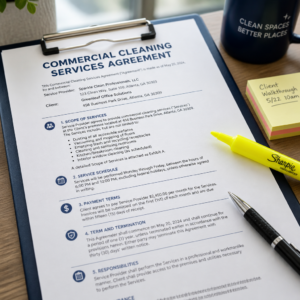
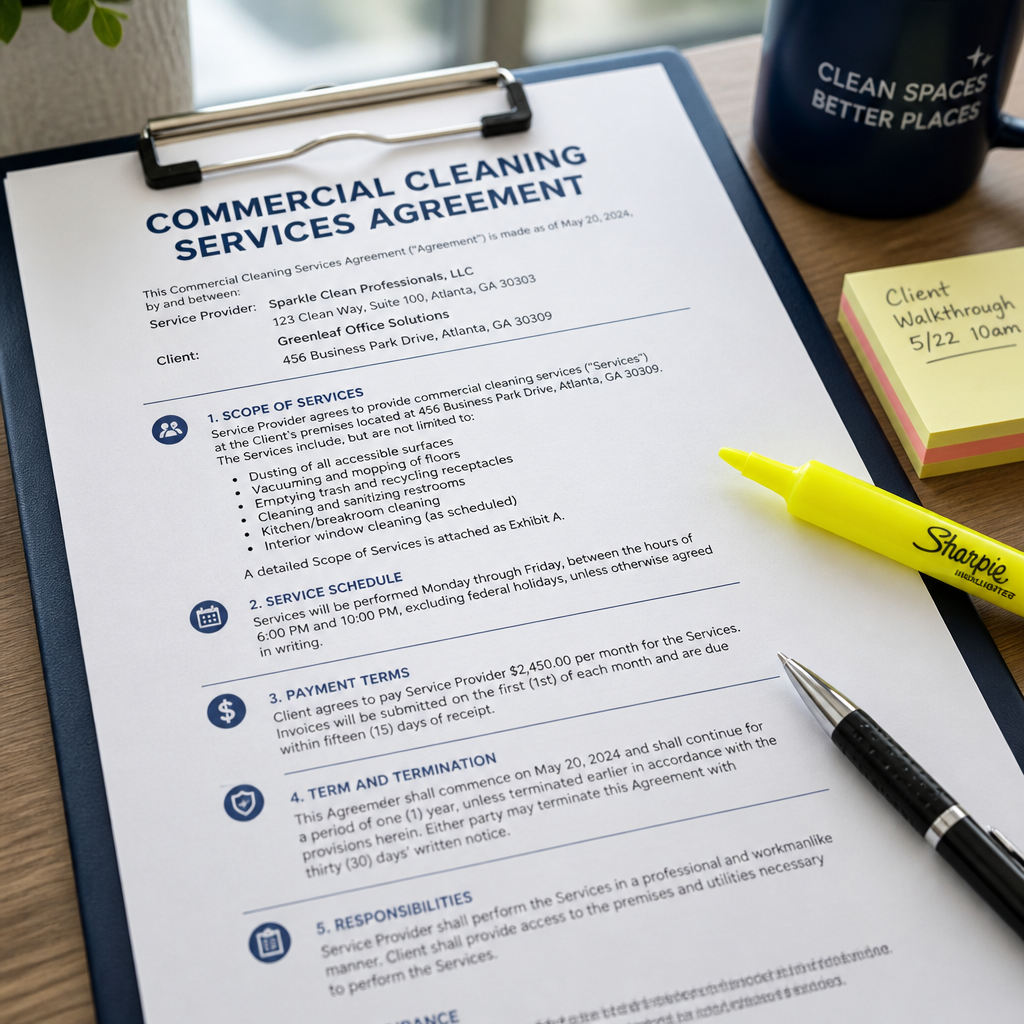
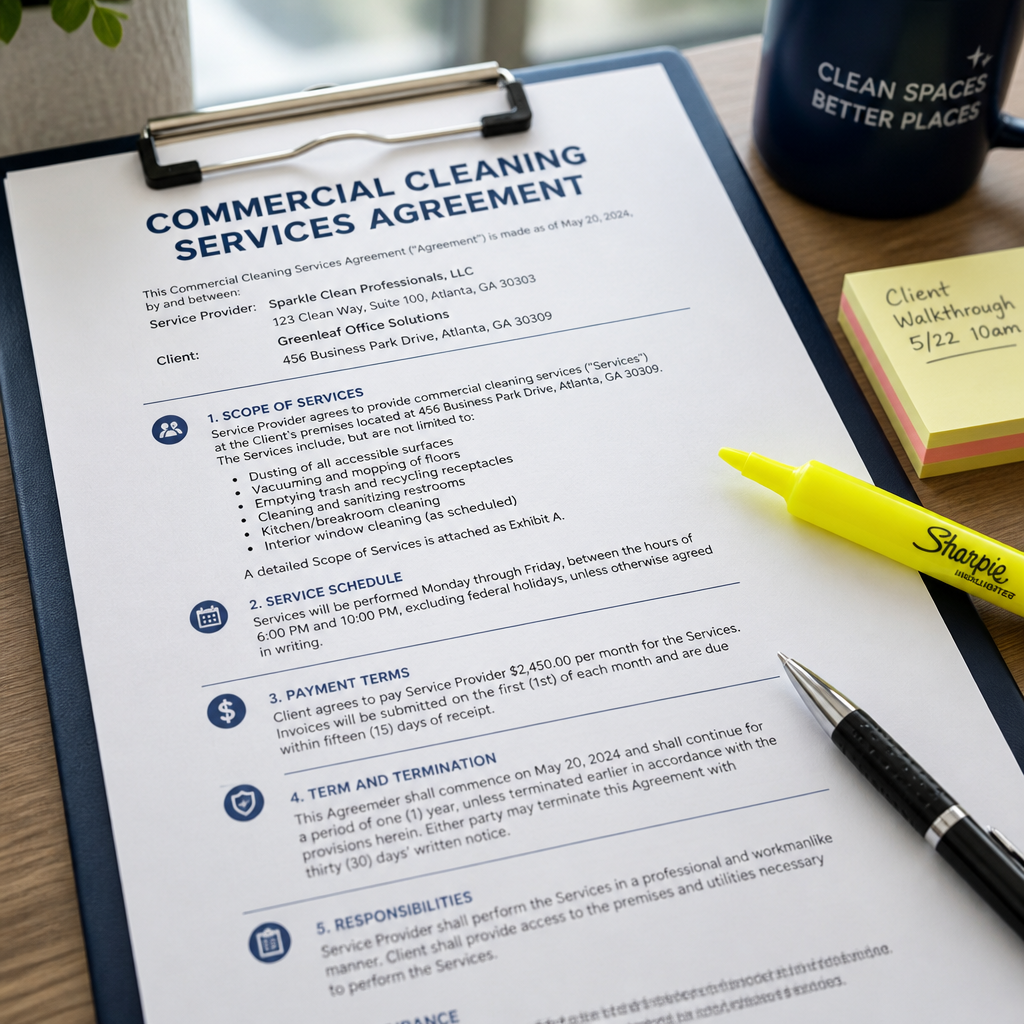
A well-structured cleaning service agreement in Christchurch or Auckland is not a formality. It is the document you will return to when a tenancy inspection exposes an issue, when a staff member reports a hygiene problem, or when you need to escalate a performance failure. Every clause that is missing from that document is a risk you are carrying personally.
Party Details and Premises Description
The contract must clearly identify both parties by full legal name and specify every premises covered by the agreement. For multi-site operations, each site should be listed separately with its address, access instructions, and any relevant security or induction requirements. Vague descriptions like “the office building at 123 Main Street” without room-level detail leave too much open to interpretation.
Services to Be Provided and Supply Responsibilities
The agreement must state exactly which cleaning services are included, whether the provider supplies their own products and equipment, and who bears the cost of consumables such as paper products and soap dispensers. If the provider does not supply products, that must be explicitly stated. A contract that is silent on this point will produce a billing dispute within the first month.
Fees, Invoicing, and Payment Terms
Pricing should be fixed and itemised, not quoted as a range. The contract should state the invoicing frequency, payment due date, and the consequences of late payment. For ongoing commercial agreements, any mechanism for price variation, such as CPI adjustments or annual review provisions, must be spelled out rather than left to verbal discussion at renewal time.
Term, Renewal, and Termination
The agreement should specify the contract start date, the initial term, and how renewal works. Critically, it must include a termination clause that defines the notice period required by each party, the grounds for early termination, and whether termination for cause requires a prior rectification process. Without this, exiting a poor-performing contract can become a legal dispute in itself.
Pro tip: Always confirm that the cleaning company’s public liability insurance certificate is current and that your premises are covered before signing. An UpstreamNZ approved supplier like Triple Star Commercial Cleaning will provide this documentation as a standard part of onboarding, but you should request it regardless of who you engage.
Writing a Scope of Work That Leaves No Room for Guesswork
The scope of work is the most important section of any commercial cleaning contract and the section most often written badly. A scope that says “clean all areas of the office three times per week” is effectively meaningless. It tells the cleaner nothing about what standard each area must meet, which surfaces require which treatment, or how different zones within the same building should be prioritised.
Room-by-Room Task Breakdown
A professional scope of work is organised by area: reception, open-plan office, meeting rooms, kitchenette, bathrooms, stairwells, and any specialist zones like server rooms or medical consultation rooms. For each area, the scope lists the specific tasks to be completed, the required frequency (daily, weekly, monthly), and any product or method restrictions. For example, a medical centre in Christchurch will have different disinfection requirements for waiting rooms than a retail store in Auckland’s CBD.
Frequency and Scheduling Detail
The contract should specify the exact service window: which days, what hours, and whether after-hours access requires a separate induction or security procedure. For buildings with multiple tenancies, the cleaning schedule must account for which areas are serviced when, to avoid disrupting occupied spaces. The schedule should also address what happens on public holidays and how catch-up services are handled.
Specialist and One-Off Services
Regular maintenance cleaning is typically on a fixed schedule, but many commercial properties also require periodic specialist services: carpet cleaning, floor stripping and sealing, window cleaning, and builders cleaning after fit-outs or renovations. Each of these should either be included in the scope with their own frequency and pricing, or explicitly excluded with a process for requesting them as variations.
A contract that defines what will be done, how often, to what standard, and what happens when that standard is not met is not just a legal document. It is the operating manual for your cleaning programme.
Performance Standards and KPIs You Can Actually Enforce
Without defined KPIs and performance standards, a contract can only be managed by opinion. With them, it can be managed by evidence. This distinction matters enormously when you are trying to hold a provider accountable or when you need to justify terminating an agreement early.
What Good KPIs Look Like
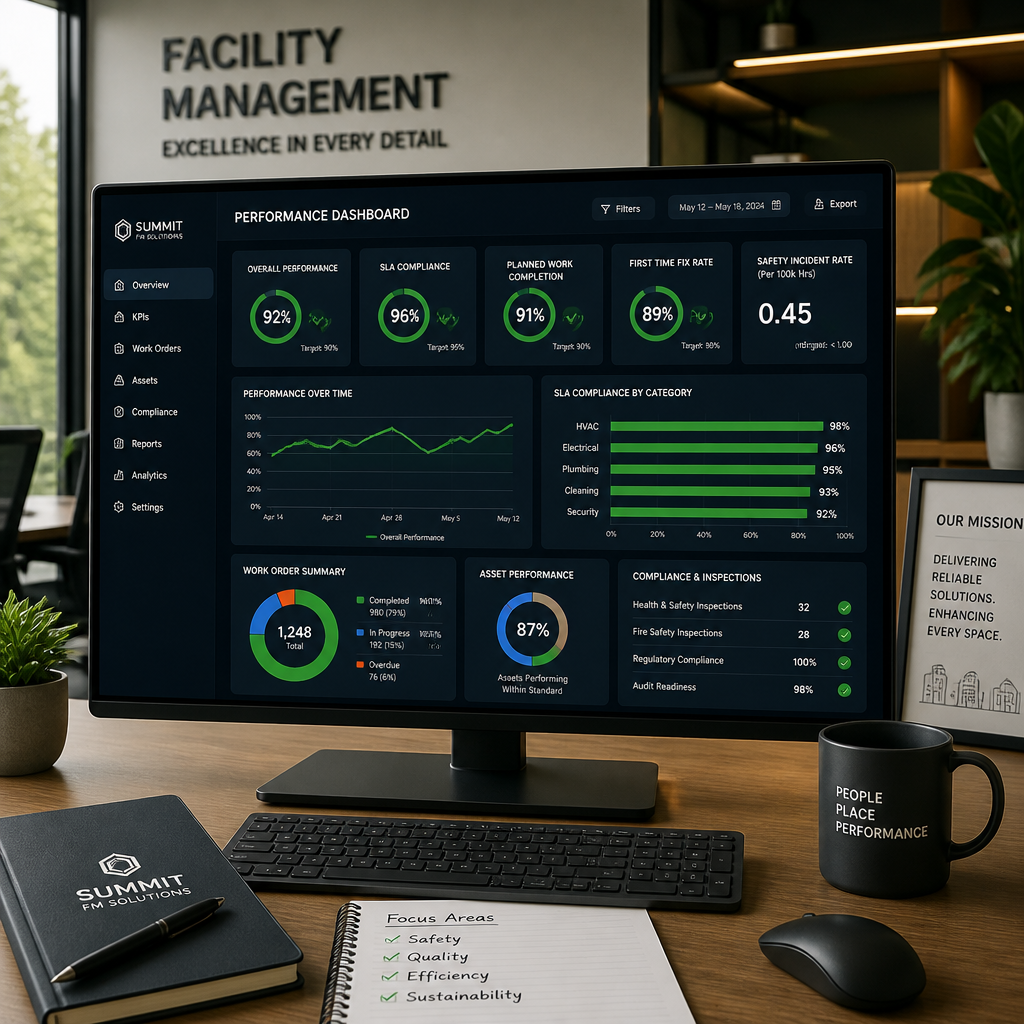
Measurable KPIs for a commercial cleaning contract in NZ typically include: a minimum pass rate on scheduled site inspections (for example, 90% of inspection items rated satisfactory or above), a maximum response time for complaint rectification (commonly 24 to 48 hours for standard issues), an attendance compliance rate (the percentage of scheduled services completed on time), and documented sign-off procedures for completed services. These metrics give both parties a clear, objective benchmark rather than a subjective opinion about whether the building “looks clean.”
Inspection and Reporting Protocols
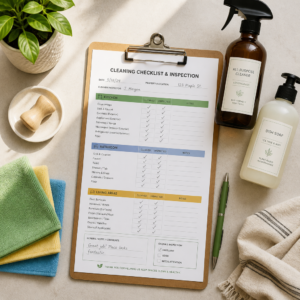
The contract should specify who is responsible for conducting inspections, how often they occur, and how results are recorded and communicated. For larger commercial buildings or multi-site portfolios managed from Christchurch or Auckland, a digital reporting mechanism is worth specifying: it creates an auditable record that protects both parties and reduces the management overhead for the facility manager.
Pro tip: Schedule a formal review meeting at three months after contract commencement, even if everything appears to be running well. This is the point at which initial standards start to drift if not actively reinforced. Use it to review inspection records, confirm the scope is still accurate for the current use of the space, and address any minor issues before they become complaints.
Contract Clauses and Gaps That Will Cost You Later
Certain contract gaps consistently create problems for facility managers and property owners in New Zealand. Knowing what to look for when reviewing a proposed agreement is as valuable as knowing what to include.
Vague Language Around Standards
Phrases like “maintain the premises in a clean and tidy condition” or “clean to a high standard” appear in many cleaning contracts and are essentially unenforceable. They invite subjective disagreement. Replace this language with specific measurable criteria. “Bathrooms sanitised daily with hospital-grade disinfectant, floors mopped on each visit, bins emptied and relined” is a standard that can be inspected and confirmed.
Automatic Rollover Clauses Without Notice Requirements
Some commercial cleaning agreements include automatic renewal provisions that lock you into another full term unless you give written notice within a specified window, sometimes as short as 30 days before the expiry date. If you are managing multiple contracts across a busy portfolio, it is easy to miss that window. Always check the renewal mechanism and diary the notice date at signing.
Missing Dispute Resolution and Rectification Periods
If the contract does not define how disputes are raised and resolved, you are left with informal confrontation or legal escalation, with nothing in between. A structured dispute resolution clause should outline the rectification process: the timeframe within which a complaint must be acknowledged, the timeframe for the issue to be corrected, and the escalation path if it is not. This protects both parties and keeps the relationship professional when things go wrong.
No Subcontracting or Staff Substitution Controls
For sensitive environments like medical centres, schools, or secure office buildings in Auckland or Christchurch, it matters who physically enters the premises. If the contract does not address subcontracting, the provider can legally send unvetted staff or contractors to your site without your knowledge. At minimum, require that all staff and subcontractors meet the same vetting standards, and that you are notified before any permanent staff change occurs at your site.
Comparing Contract Structures: Fixed, Periodic, and Ad Hoc
Facility managers in New Zealand typically encounter three commercial cleaning contract structures. Each suits different operational contexts, and understanding the trade-offs helps you choose the right one for your building or portfolio.
| Contract Structure | Best Suited For | Key Risks to Manage |
|---|---|---|
| Fixed-Term Contract (typically 12 to 24 months) | Office buildings, schools, medical centres, and retail sites requiring consistent scheduled cleaning. Suits organisations wanting price certainty and a stable provider relationship. | Automatic rollover clauses, price lock-in without CPI provisions, difficulty exiting early if performance deteriorates. Requires a clear termination for cause mechanism. |
| Periodic (Rolling) Contract (month-to-month or quarterly) | Properties with variable occupancy, construction projects, or businesses that want flexibility before committing to a longer engagement. Also useful when trialling a new provider. | Higher hourly or service rates compared to fixed terms. Provider has less incentive to invest in site knowledge. Less predictability for scheduling around events or seasonal peaks. |
| Ad Hoc or One-Off Services | Post-construction cleaning, end of lease cleaning, flood restoration, or carpet cleaning required outside a standing agreement. Common for real estate agencies and property managers handling tenancy transitions. | No standing relationship means the provider has less site-specific knowledge. Scoping and quoting take longer. Insurance and compliance checks must be performed fresh each time. |
For most commercial property managers in Christchurch or Auckland managing one or more buildings with regular cleaning needs, a fixed-term contract with a clear scope, measurable KPIs, and a documented exit mechanism will produce the best outcomes. The periodic option is useful as a trial before committing, but it should be treated as a transitional arrangement rather than a permanent structure.
Compliance, Insurance, and Health and Safety in NZ
New Zealand’s Health and Safety at Work Act 2015 places clear obligations on both facility managers and their cleaning contractors. As a Person Conducting a Business or Undertaking (PCBU), a facility manager has a duty to ensure that contractors working on their premises are operating safely. That duty does not disappear because the cleaning provider is an independent contractor.
What to Verify Before Signing
Before any cleaning contract is executed, the facility manager should confirm: that the provider holds current public liability insurance appropriate to the scale of the work; that staff are trained in the correct use of chemicals and equipment; that site-specific health and safety induction requirements are communicated in writing; and that the provider has a documented system for reporting incidents or near-misses that occur on your premises.
Security and Access Protocols
The cleaning service agreement must specify the exact process for granting access to secured areas: alarm codes, key handling procedures, access card management, and the protocol for responding if a security breach occurs. For buildings in Auckland’s CBD or Christchurch’s commercial precincts where after-hours access is standard, this section is not optional. A provider with experience in commercial settings will have a documented key management policy as a matter of course.
Industry Accreditation as a Baseline Check
Approved supplier status through networks like UpstreamNZ provides an independent benchmark that a provider has met minimum commercial standards. It does not replace your own due diligence, but it meaningfully reduces the research burden when you are evaluating a new provider. Triple Star Commercial Cleaning holds UpstreamNZ approved supplier status and carries public liability insurance across all cleaning sites, which simplifies the compliance verification process for property managers working with their network.
Managing the Contract After Signing
Signing a well-structured commercial cleaning contract is not the end of the process. It is the beginning of a service relationship that requires active management to stay on track. A common mistake among facility managers is to treat the contract as a set-and-forget document, only revisiting it when something goes wrong.
Regular Inspections and Documentation
Conduct structured site inspections on a regular basis, using the KPIs defined in the contract as your benchmark. Document the results. If you only inspect when you notice something wrong, you are managing reactively and you have lost the paper trail that would protect you if termination ever becomes necessary. Weekly or monthly inspections catch issues at the point when they are still easy to correct.
Handling Performance Issues Formally
If the cleaning provider is not meeting the contracted standard, put it in writing. A formal email or notice that documents the specific shortfall, references the relevant clause in the contract, and sets a defined timeframe for rectification is far more effective than a phone call. It creates a record that protects you, and it signals to the provider that you are managing the contract seriously. Verbal complaints are easily forgotten or disputed. Written ones are not.
Scope Reviews at Lease Changes or Fit-Outs
The cleaning scope that was accurate when the contract was signed may no longer reflect the reality of the building after a tenancy change, a refurbishment, or the addition of new common areas. Build a scope review into any significant change to the premises. For post-construction cleaning and fit-out scenarios, a separate scope addendum is usually the cleanest approach rather than amending the core agreement.
For facility managers overseeing properties in both Christchurch and Auckland, working with a provider that operates across both cities under a single contract framework eliminates the risk of mismatched standards, duplicate supplier management, and inconsistent service delivery across your portfolio. Triple Star’s office cleaning services are structured specifically to support multi-site property managers who need consistent outcomes across both cities without doubling their management overhead.
Frequently Asked Questions
What should a commercial cleaning contract in NZ legally include?
At minimum, a legally sound commercial cleaning contract in New Zealand should include the full names of both parties, a detailed scope of work, the service frequency and schedule, fees and payment terms, the contract term and renewal mechanism, a termination clause with notice periods, liability provisions, and a dispute resolution process. Insurance requirements and health and safety obligations should also be addressed in writing. A contract that omits any of these elements creates legal and operational risk for both parties.
How long should a commercial cleaning contract be?
For most commercial properties in Christchurch and Auckland, a 12-month initial term is standard. This gives both parties enough time to establish a working relationship and measure performance against the agreed KPIs, without locking either party into an arrangement that is not working. Some buildings with complex requirements or significant set-up costs on the provider’s side may warrant a 24-month term, but this should only be agreed if the termination for cause provisions are clearly defined and fair.
Can a facility manager terminate a cleaning contract early?
Yes, but the ability to do so, and the process for doing it, depends entirely on what the contract says. A well-structured cleaning contract will include a termination for cause provision that allows early exit if the provider fails to meet the agreed standards after a formal rectification process. Without this clause, early termination may constitute a breach of contract and expose the facility manager to a damages claim. Always negotiate termination rights before signing, not after a problem has already emerged.
What is a reasonable notice period for ending a cleaning contract?
Most commercial cleaning contracts in New Zealand use a 30-day written notice period for termination without cause at the end of a term, and a similar or shorter period for termination for cause following failed rectification. Longer notice periods of 60 to 90 days are sometimes seen in large or complex contracts where transitioning to a new provider takes more time. Whatever period is agreed, it should be the same for both parties, not weighted in favour of the provider.
Does a commercial cleaning company in NZ need to carry public liability insurance?
Yes. Any commercial cleaning provider operating on your premises should carry current public liability insurance. This protects both parties if property is damaged or a person is injured during the provision of cleaning services. You should request a copy of the provider’s insurance certificate before work commences and confirm that the level of cover is appropriate for the scale and nature of the work. Providers with UpstreamNZ approved supplier status, such as Triple Star Commercial Cleaning, carry public liability insurance across all cleaning sites as a standard requirement.
How should one-off or variation services be handled in a cleaning contract?
Any service that falls outside the agreed scope, including ad hoc carpet cleaning, post-construction cleaning, flood restoration, or additional areas added to the schedule, should be requested in writing and confirmed with a written quote before the work is performed. A variation clause in the main contract should establish this process formally. Without it, ad hoc services are often invoiced at rates that were never agreed, and verbal approvals become disputed. For services like carpet cleaning or floor stripping and sealing, the variation process also allows the facility manager to confirm scheduling and access arrangements in advance.
What is the difference between a cleaning contract and a service level agreement?
A cleaning contract is the legally binding document that governs the overall relationship: parties, term, pricing, liability, and termination. A service level agreement (SLA) is typically a schedule or addendum to that contract that defines the performance standards in detail: KPIs, inspection frequencies, response time benchmarks, and escalation procedures. In practice, a well-drafted commercial cleaning contract will incorporate SLA elements directly rather than as a separate document, but some larger organisations prefer to manage them separately so the SLA can be updated without renegotiating the main contract.
If you manage commercial properties in Christchurch, Auckland, or both and you have questions about what a well-structured cleaning agreement should look like for your specific buildings, we would welcome your experience and feedback in the comments below.
We would love your feedback and any insights you would share with others. What perspective would you add?
References
- LegalVision NZ guide to key terms in cleaning business contracts under New Zealand law
- LawDepot NZ overview of cleaning services agreement structure and indemnification provisions
- Industry guide to how commercial cleaning contracts are structured in New Zealand
- New Zealand Government procurement guidance on tailored cleaning services contracts